What People Ask AI About Lithium Batteries & Lithium Inverters in India
AI gives neat answers. Field reality is messier: cutoff mismatch, charge-current sizing, and chemistry that must never be mixed. Three questions Indian buyers ask most — answered by an industry expert.
Kunwer Sachdev
Inverter Man of India
30+ years in inverter & battery industry
📅 October 2026⏱ 8 min read🇮🇳 India · Home lithium backup
Search or ask ChatGPT about lithium for home backup and you will hear the same three questions again and again: Can I put lithium on my old inverter? Is any “lithium inverter” fine? Can I keep my tubular and add lithium? Generic AI answers often skip the BMS reconnect trap, the charge-current rule that sizes the battery, and the hard no on mixing chemistries.
Q1: Possible on an existing inverter, but risky — match cutoffs and ask how the BMS reconnects after cutoff. Q2: Specs beat labels — charge current (~25% of Ah), BMS vs inverter voltages, ideally Bluetooth/USB BMS link. Q3: Never mix tubular and lithium in parallel or series.
Q1. Can I install a lithium battery on my existing inverter?
Yes, it is possible — but it is risky if you treat it like a drop-in tubular swap.
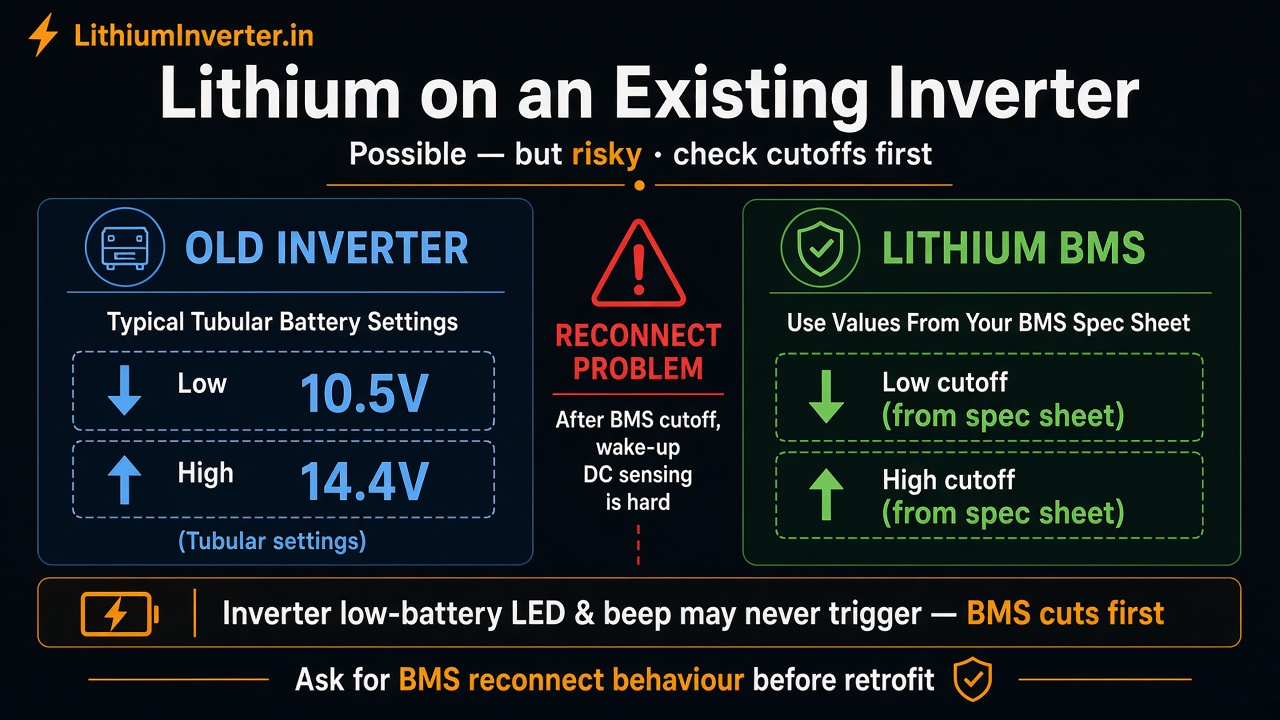
Most existing home inverters were designed for tubular / lead-acid batteries. Their battery low cutoff and battery high cutoff are typically set around 10.5V (low) and 14.4V (high) on a 12V system (scale roughly 2× / 4× for 24V / 48V). Lithium packs already have their own BMS with low/high cutoffs printed on the spec sheet. Those two protection layers must be checked against each other before you buy — not after installation. If motor loads make a lithium pack trip where tubular did not, read inverter surge current & BMS.
Existing inverter cutoffs vs lithium BMS cutoffs — and why reconnect after BMS trip is the hard part.
The biggest challenge is not the first cut. It is reconnect after BMS cutoff. When the lithium BMS trips on low voltage or high voltage, it goes into cutoff. To reconnect, the BMS usually needs DC voltage sensing / a wake-up path. Many existing inverters do not handle that cleanly, so the system can sit “dead” even though the pack still has energy, or charge recovery becomes unreliable.
I designed the BMS in Su-vastika specifically to handle these reconnect and cutoff challenges with existing inverters. Even then, another practical issue remains: the inverter’s low/high battery LEDs and beep often stop behaving as users expect. Because the lithium BMS typically cuts earlier than the inverter’s own warning thresholds — especially on low battery — the inverter never reaches the point where it would light the LED or sound the alarm. So users lose the warning behaviour they were used to with tubular batteries.
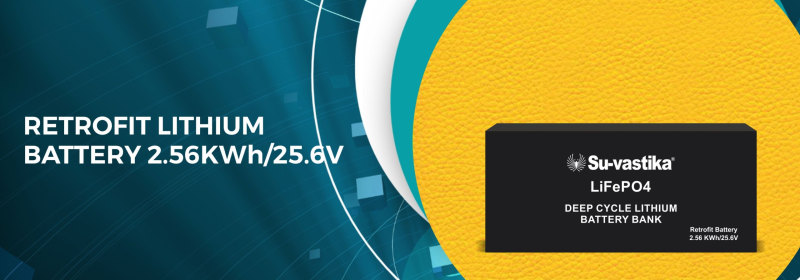
Example of a retrofit LiFePO4 pack (2.56 kWh / 25.6V) built for existing inverters — BMS engineered for lead-acid charger behaviour, not a blind tubular swap.
Before buying lithium for an existing inverter, ask:
BMS low and high cutoff — from the lithium pack spec sheet
How the pack reconnects / wakes after low-voltage or high-voltage cutoff
Charge / float profile compatibility with that pack
Which warnings you keep or lose on low-battery LED and beep
If the seller cannot answer these clearly, do not retrofit yet.
Independent press has covered this retrofit direction — including pv magazine India’s feature on making existing lead-acid inverters lithium-compatible with the right BMS approach.
Q2. Do I need a lithium inverter — or is a “lithium” sticker enough?
You need a lithium inverter that is actually compatible with the lithium battery — and you must check the specs before buying. Writing “lithium inverter” on the box is not enough.
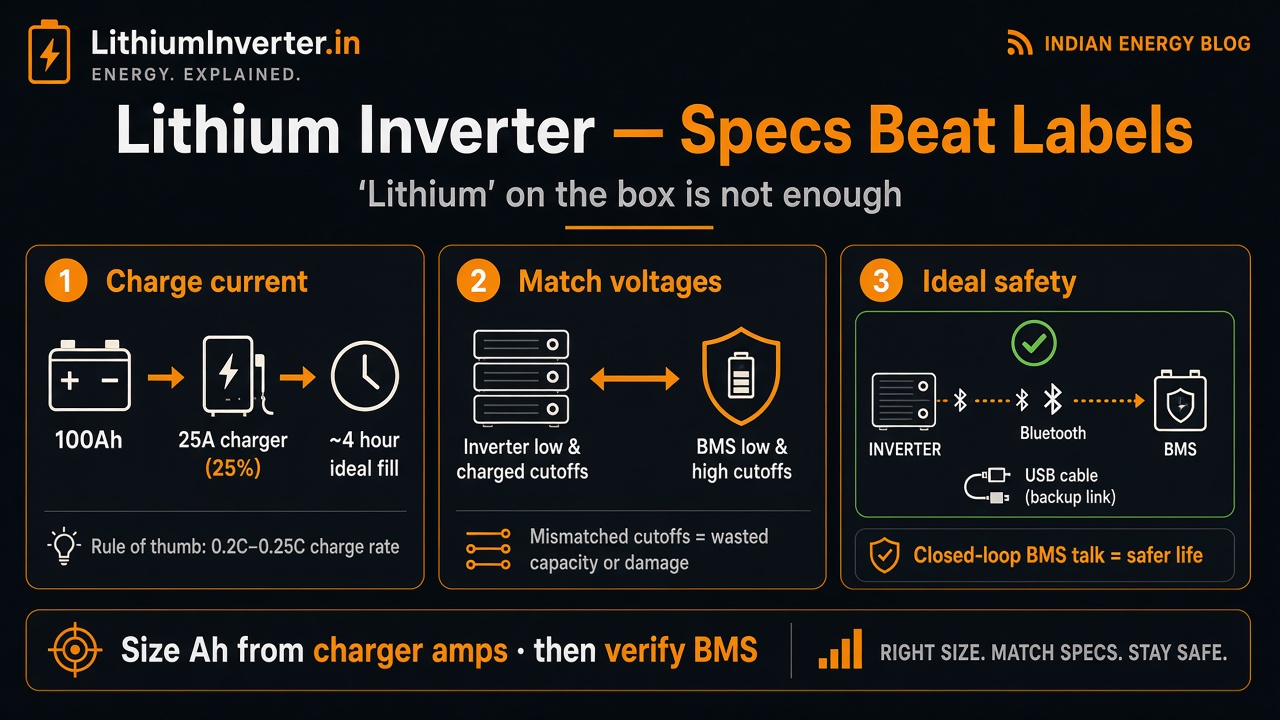
Charge current sizes the battery; BMS voltage match and closed-loop communication finish the safety case.
1. Charging current defines battery capacity
Lithium should be charged at about 25% of battery capacity so a full charge can finish in roughly 4 hours or less. Example: a 100Ah lithium battery ideally needs a ~25A charger in the lithium inverter. If the inverter’s charge current is much lower, the pack will take too long to refill between outages; if you ignore this when sizing, you buy the wrong Ah for your real-world grid windows. For load-based sizing and chemistry choice, see the best inverter battery buyer’s guide.
Lithium pack
Ideal charge current (~25%)
Approx. fill time
100Ah
~25A
~4 hours
150Ah
~37–40A
~4 hours
200Ah
~50A
~4 hours
2. Match BMS cutoffs to the inverter
Check the battery BMS low-cutoff and high/charged voltages against the inverter’s low-battery and charged-battery settings. If they don’t line up, you get early cutoff, incomplete charge, or the reconnect problems covered in Q1. BMS voltage control is not optional marketing — standards such as IEC 62619 treat the BMS as the system that prevents overcharge, overcurrent and overdischarge.
3. Ideal combo: inverter ↔ BMS communication
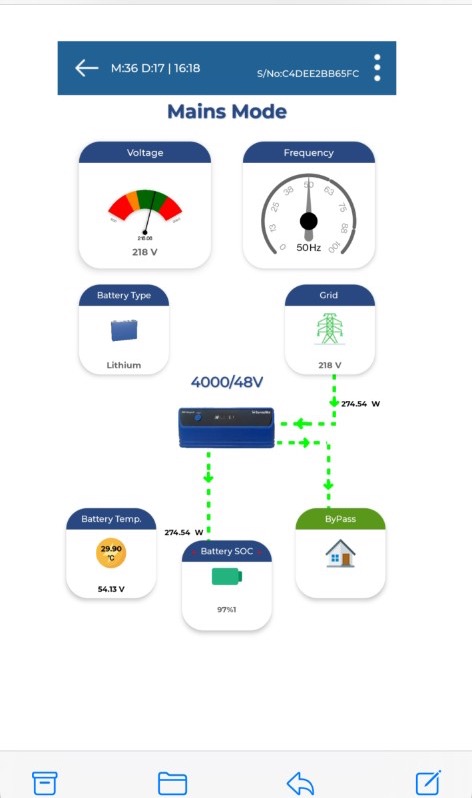
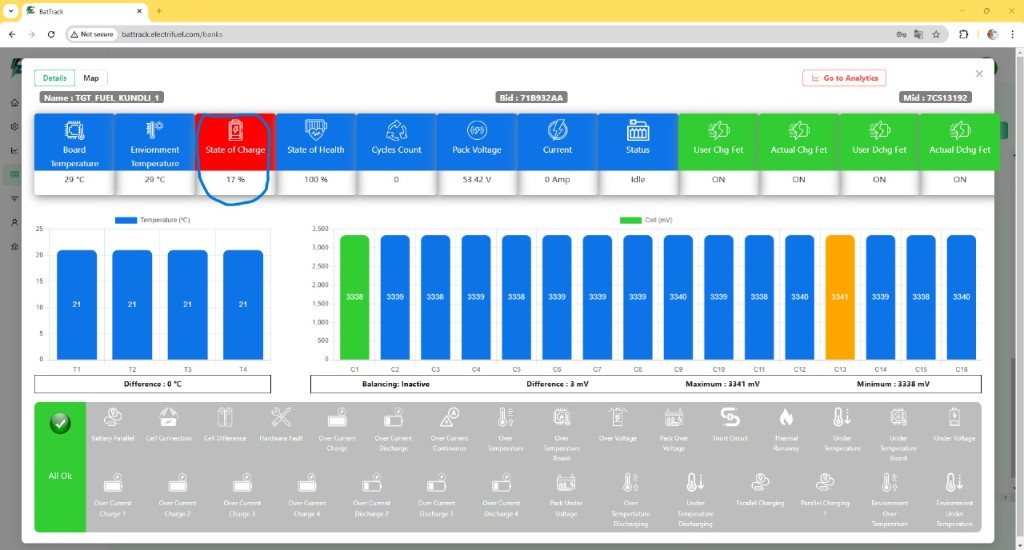
Best case is a lithium inverter that talks to the BMS over Bluetooth or USB (or an equivalent closed-loop link). That is the safer combination for protection, state-of-charge accuracy, and long-term battery life — not just an open-loop voltage guess from the inverter. Below is what that looks like in the field: the inverter app knows the pack is Lithium and shows live SOC, while the BMS software shows every cell voltage and FET status.
Inverter app: Lithium selected, live SOC and power flow over the link.BMS view: cell-by-cell voltages, SOC, temperatures and FET status — the data a closed-loop inverter should use.
On a phone this stack becomes one column; on desktop you see inverter app + BMS side by side.
"Size Ah from the charger amps. Then verify BMS voltages. Prefer a link that talks to the BMS — labels don't protect cells."
Q3. Can I mix lithium with tubular (parallel or series)?
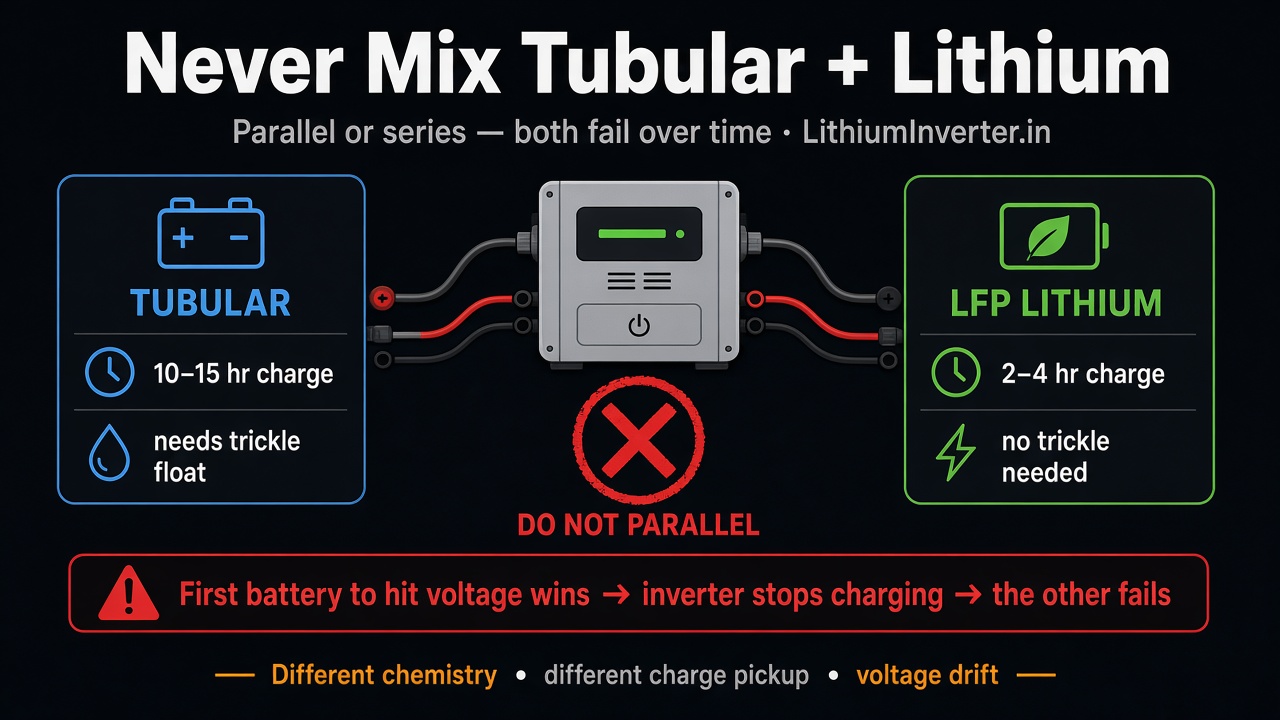
No. This should never be done — parallel or series.
Shared charge path + different chemistries = one pack “wins,” the other fails over time.
If both batteries sit on the same inverter charge path, charging current hits both at once, but each builds voltage on its own chemistry and state. Whichever battery reaches the inverter’s “battery charged” (or related voltage) threshold first will make the inverter stop charging. The other pack is left unfinished. Over time that pack is chronically undercharged or stressed and starts failing. Even if you carefully match voltages at install, charge pickup differs, so a voltage difference grows over weeks and months.
Chemistry mismatch makes it worse:
Tubular needs a proper long charge — often 10–15 hours — to protect life and control water loss
Lithium performs best with a faster fill — typically 2–4 hours
Tubular needs constant trickle / float because self-discharge is high
Lithium does not need that same trickle behaviour (float and trickle are the same top-up idea for lead-acid)
Kunwer Sachdev — known as the Inverter Man of India and the Solar Man of India. Founder of Su-Kam, holder of Kunwer Sachdev's 106 technology filings, mentor to Su-vastika and other technology companies, and founder of Kunwwer.ai for AI software development. Read his story →
Disclaimer: This article reflects the personal views and field experience of Kunwer Sachdev. He is not responsible for the product quality, services, or dealings of any third-party company. Kunwer Sachdev exited Su-Kam in 2019 and is not responsible for any activity of the company since. Full disclaimer →