Yes — you can put a 51.2V lithium (LiFePO4) battery into your existing 48V inverter and keep the inverter. A 48V inverter charges at about 57.6V, and a 51.2V LFP pack is built from 16 cells (3.2V each = 51.2V) that charge at 3.6V × 16 = 57.6V — the same voltage your inverter already outputs. So bulk charging is fully compatible. The two real catches are the continuous trickle charge and waking the battery after a low-voltage cutoff — both solved by a proper retrofit BMS.
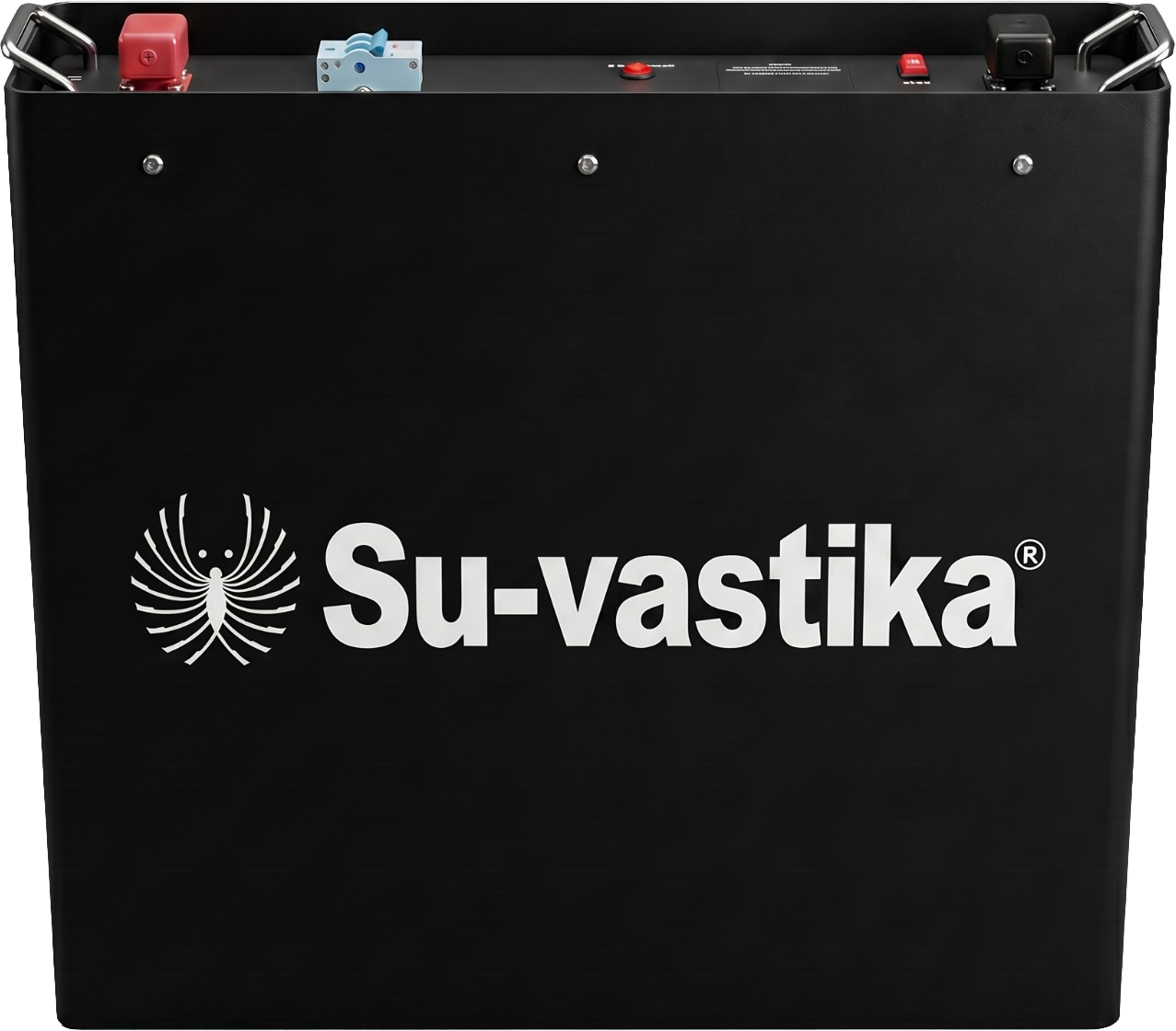
Why 51.2V matches your 48V inverter
A 48V lead-acid system and a 51.2V LFP pack line up more closely than people expect. The difference is only what happens after the battery is full, and how deep it can safely go:
| Parameter | 48V lead-acid inverter | 51.2V LFP retrofit |
|---|---|---|
| Nominal voltage | 48V | 51.2V (3.2V × 16 cells) |
| Bulk / absorption charge | ~57.6V | 57.6V (3.6V × 16) — same |
| Trickle / float after full | Continuous | Must be stopped — retrofit BMS does this |
| Low-voltage cutoff | ~46V (~50% usable) | ~42V (~80% usable) — goes deeper |
Because the LFP cutoff is much lower (42V vs 46V), the lithium pack keeps delivering power long after a lead-acid battery would quit — more usable backup from the same nominal size.
Catch 1: the trickle charge after full
Once full, a lead-acid inverter holds the battery topped up with a small continuous trickle/float current. Right for lead-acid, wrong for LFP, which should rest. A retrofit BMS intercepts that trickle stage (or uses the inverter's lithium mode), keeping the cells healthy while the inverter still sees a normal battery.
Catch 2 (the big one): waking up after low-voltage cutoff
This is the problem that kept lithium off normal inverters for years. When the battery drains to its low-voltage cutoff, the BMS disconnects to protect the cells. On a generic lithium battery the BMS then goes idle and stops sensing — so when the grid returns and the inverter tries to charge, the sleeping BMS never wakes. It cannot detect the incoming recovery voltage, the pack stays dead, and the inverter cannot revive it. For the inverter industry this has been the single biggest obstacle to lithium.
A proper retrofit BMS is built for exactly this: it keeps sensing the line and battery voltage even after cutoff. The moment mains power returns it detects it and reconnects to start taking charge — automatically, with no manual reset. That auto-wake behaviour is what makes a 51.2V retrofit pack behave like a battery your inverter can always recover and recharge.
Catch 3: the inverter’s start-up surge
An inverter cold-starts on the battery, not the grid. At first switch-on it pulls a large inrush current from the 48V pack to charge its capacitors and start — this has nothing to do with the load you attach. A tubular battery gives that surge freely; a generic lithium BMS can block it, so the inverter never starts. A retrofit BMS sets a high enough surge limit to let the inverter start, then resumes normal protection (high cut 57.6V, low cut 42V on a 51.2V pack). Full explanation with diagram →
What the retrofit BMS actually does
The BMS is the brain that makes a normal inverter and a lithium battery work together. A genuine retrofit BMS:
- Cuts off the trickle / float charge once the battery is full — the inverter would otherwise keep topping up the cells, which damages LFP. The BMS stops it.
- Keeps sensing after low-voltage cutoff and auto-reconnects the instant mains returns, so the inverter can always wake and recharge the pack.
- Balances every cell (cell equalisation) so the pack charges evenly and lasts its full life.
- Protects against overload, short circuit, over-voltage, deep discharge and over-temperature.
- Sleeps to save power after shutdown — a retrofit pack can hold standby charge for a month or more.
- Charges fast — your existing inverter fills it in about 4–5 hours, versus ~15 hours for a tubular battery.
- Works with any brand of 12V, 24V or 48V inverter / UPS made in the last decade.
- Allows the inverter’s start-up inrush — at first switch-on the inverter draws a surge from the battery to start; a generic BMS blocks it, a retrofit BMS lets it through. more →
Who the 48V (5.12 kWh) pack is for
48V inverters and solar PCUs use four batteries in series. The 48V (5.12 kWh) pack replaces all four, built for large homes, villas and small offices, and the best base for adding solar later.
| Home | Load | Backup | Pack |
|---|---|---|---|
| Large home / office — rooms, fridge, pumps | 1000–2200W | 3–6 hrs | 48V 5.12 kWh (≈100Ah)+ |
Why trust this — 30+ years and patented technology
This guidance comes from Kunwer Sachdev, the “Inverter Man of India.” He pioneered India's first plastic-body inverter, and has spent 30+ years building the country's power-backup and energy-storage industry. He now mentors Su-vastika, where this retrofit lithium technology is engineered.
This retrofit BMS approach builds on Kunwer Sachdev's patented battery-management work — including Indian Patent No. 436188, “System for Real-Time Monitoring of a Battery Using Battery Management System” (filed by Kunwer Sachdev), plus an Intelligent Battery Equalizer (No. 411360) and a Battery Charge Equalizer that works irrespective of battery type (No. 432802). See all of Su-vastika's Patents & Certificates (25+ granted).
Go deeper: Full retrofit technical guide · Retrofit battery range · kunwersachdev.com · Solar Man of India
Two indicator quirks to expect (and explain to customers)
Because an inverter’s front-panel LEDs are calibrated for lead-acid voltages, two normal effects are often reported as “faults” after a lithium retrofit. Both are simply the BMS doing its job at the correct lithium voltages:
- The “fully charged” light may not come on. The BMS stops charging once the LFP pack reaches its full (high-cut) voltage — which happens before the inverter sees the higher voltage its lead-acid “charged” LED expects. The battery is full; the inverter just never reaches its old trigger point, so the charged light stays off.
- The “low battery” light or alarm may not come on. The BMS disconnects at the LFP low-voltage cutoff, which it reaches before the inverter’s lead-acid “low battery” threshold. So the inverter switches off (because the BMS opened the circuit) without first flashing the low-battery warning.
Neither is a fault — the BMS protects the cells at lithium voltages, not the lead-acid ones the LEDs were tuned for. Setting the inverter to lithium mode (where available) or using a Type 3 (RS485/CAN) BMS restores accurate charged and low-battery indication. It is worth telling customers these two points up front so they are not mistaken for a fault.
What a 48V retrofit costs in 2026 (and the 10-year maths)
A 48V LFP retrofit pack (51.2V, 5.12 kWh) costs about ₹90,000–1,40,000 in 2026 — more upfront than tubular, but tubular lasts only 3–5 years and must be bought again and again, while one LFP pack runs 8–12+ years at 4,000+ cycles. Over a decade the lithium pack is the cheaper path, and (per the C20-vs-C1 point above) it delivers more real backup than the bigger tubular bank it replaces.
| Over 10 years | What you buy | Approx spend |
|---|---|---|
| Tubular replacement cycle | four 150Ah tubulars (~₹48,000–56,000), replaced ~3–4× | ~₹2,00,000 + maintenance |
| LFP retrofit (one purchase) | 51.2V pack, 4,000+ cycles | ₹90,000–1,40,000 |
Per usable cycle, lithium works out far cheaper — a tubular fades after a few hundred cycles, an LFP pack delivers thousands. Full breakdown in our lithium vs lead-acid price guide.
Why a 100Ah lithium beats a 200Ah tubular
Tubular batteries are rated at the slow C20 rate — discharged gently over 20 hours. But an inverter discharges fast, closer to C1, and at that rate a tubular delivers far less than its label. So a 200Ah tubular gives only a fraction of its rating under inverter load. A lithium (LFP) pack delivers nearly its full capacity even at high discharge — which is why a 100Ah lithium gives more real backup than a 200Ah tubular, at half the rated Ah, far less weight and a much longer life. (Kunwer Sachdev explains the C20-vs-C1 maths in detail in his other articles.)
Choosing the right voltage
Match the pack to your inverter's battery voltage — never mix systems. Other guides: 12V (12.8V) · 24V (25.6V). New to this? Start with Can you put a lithium battery in your old inverter?
Frequently asked questions
Yes, with a retrofit 51.2V LFP pack. Your 48V inverter charges at 57.6V, matching the LFP charge voltage, so bulk charging works. The retrofit BMS handles the trickle charge and the cutoff-recovery that a normal lithium pack cannot.
With a generic pack, often not — its BMS goes idle at cutoff and stops sensing, so it never wakes when mains returns. A retrofit BMS keeps sensing and auto-reconnects the moment power comes back, so the inverter charges it normally.
About 57.6V for a 48V system (3.6V per cell × 16 cells) — the same as your 48V lead-acid inverter's charge voltage.
LiFePO4 does not catch fire even if punctured or overcharged, unlike the NMC in phones and EVs. Choose a BIS-certified (IS 16046) pack. See why India chose LFP.

Kunwer Sachdev — known as the Inverter Man of India and the Solar Man of India. Founder of Su-Kam, holder of 106 technology filings, mentor to Su-vastika and other technology companies, and founder of Kunwwer.ai for AI software development. Read his story →