Don't Buy “Lithium-Ion” for Home Backup in India — LFP vs NMC
The most dangerous shopping mistake is treating “lithium-ion” as one product. For homes, that phrase often means NMC — denser, colder-friendly, fewer cycles, harder fires. LFP is the chemistry India chose for a reason.
Kunwer Sachdev
Inverter Man of India
30+ years in inverter & battery industry
📅 October 2026⏱ 7 min read🇮🇳 India · Home lithium chemistry
In no case should an Indian home buyer casually choose “lithium-ion” without asking which chemistry. In the market, that label usually points to NMC (nickel-manganese-cobalt) — not LFP (LiFePO4). NMC can work when it is controlled by a strong BMS, but it typically offers fewer life cycles than LFP. Its advantage is size: higher energy density, so a smaller pack for the same energy. See also NMC on Wikipedia and our deeper India story: Why India chose LFP.
⚡ The short answer
For most Indian homes and apartments: choose LFP. Use NMC only where cold climates punish LFP and you need compact size — and only with a serious BMS. Both LFP and NMC install indoors. Never treat lithium like balcony tubular / lead-acid.
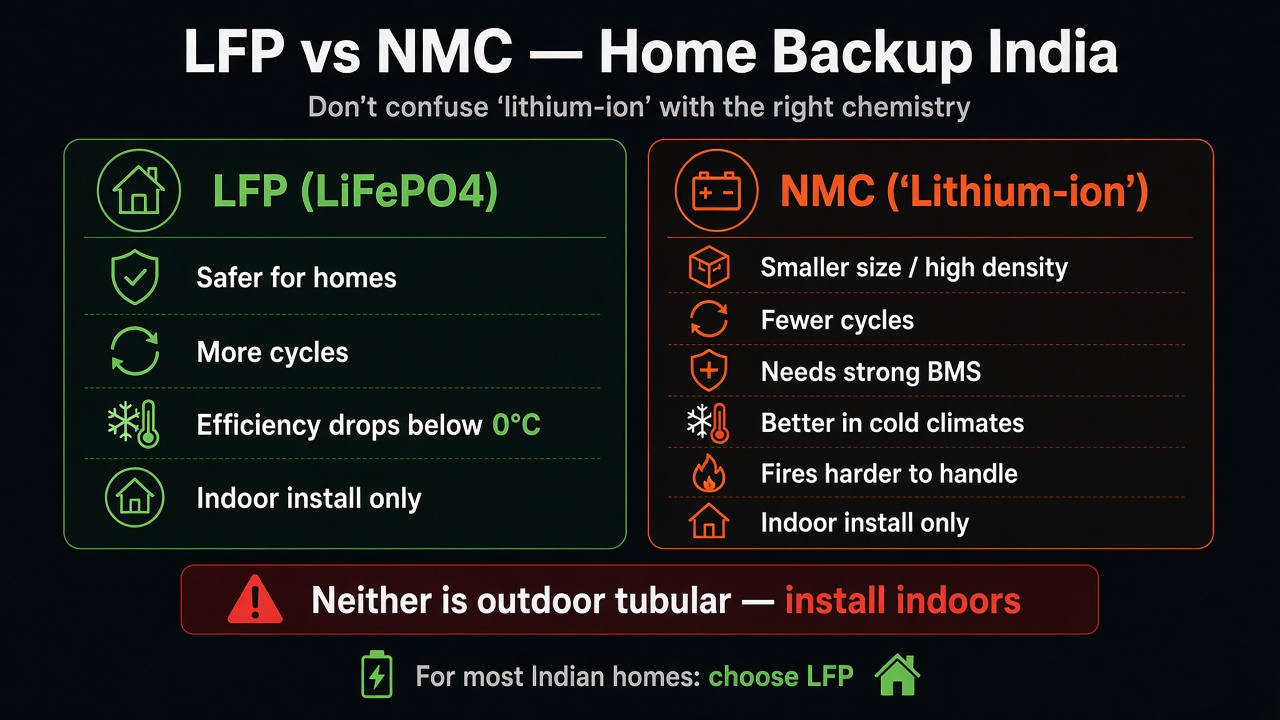
LFP vs NMC for home backup — chemistry first, label second. Indoor install for both.
What “lithium-ion” usually means on a dealer invoice
Buyers hear “lithium” and assume one safe upgrade from tubular. That is wrong. LFP and NMC are different chemistries with different cycle life, cold behaviour and fire severity. If the brochure only says “lithium-ion” and never says LiFePO4 / LFP, ask for the chemistry in writing. For how sellers confuse specs, see what brands hide on inverter battery specs and the home inverter battery buyer’s guide.
Point
LFP (LiFePO4)
NMC (“lithium-ion”)
Typical home fit in India
Default for flats & offices
Not the casual default
Cycle life
Higher (long service)
Fewer cycles than LFP
Size / density
Larger for same kWh
Smaller pack — main advantage
Cold (< ~0°C)
Efficiency / charge can suffer
Efficiency less affected
Fire severity
Generally lower than NMC
Fires harder to handle
BMS
Mandatory, quality matters
Strong BMS is non-negotiable
Install
Indoor only
Indoor only
NMC: when it is good — and what you must demand
Having NMC technology is fine if it is controlled through a strong BMS. Without that, density becomes a liability. NMC’s practical upside is packaging: less volume and weight for the same energy. That helps vehicles and some compact systems — it is not a free pass for apartment backup.
NMC also has a real climate niche. Below about 0°C, LFP efficiency and charge acceptance can fall off; NMC’s efficiency is less affected by cold. That matters in true cold regions. It does not describe a typical Indian summer flat in Delhi, Mumbai or Chennai. For BMS depth, see surge current & BMS and Kunwer on India’s BMS path.
Fire: NMC vs LFP — speak clearly
NMC fires are difficult to handle. LFP events are generally not at that level compared with NMC. That difference is why India moved hard toward LFP after the EV fire scare — documented in Why India chose LFP. Background on runaway behaviour: thermal runaway (Wikipedia).
Safety is not marketing. LFP is the safer home chemistry — it is not an excuse for fake cells, missing BMS, or outdoor “jugaad” installs. Chemistry + BMS + placement decide outcomes.
Indoor only — stop treating lithium like tubular
Both LFP and NMC batteries need to be installed indoors. Do not treat these packs like lead-acid or tubular batteries. Tubular often ends up in a balcony, bathroom corner or outdoor shed with water top-up habits. Lithium is a sealed electronics + cell system: charge profiles, BMS cutoffs and temperature windows are different. Parking a lithium pack “where the old battery was” outdoors is one of the fastest ways to create a problem you will blame on “lithium” instead of on install practice.
Install checklist: indoor location · chemistry written as LFP or NMC · BMS present and documented · inverter charge settings matched · never mix with tubular (AI Q&A: never mix chemistries) · for old inverters use a true retrofit LFP path.
"If the label only says lithium-ion, ask: LFP or NMC? For most Indian homes the answer should be LFP — indoors, with a real BMS."
No. “Lithium-ion” on many Indian invoices means NMC. Ask for LFP / LiFePO4 in writing for home and apartment systems.
Why prefer LFP in Indian apartments?
More cycles for daily cuts, safer fire behaviour relative to NMC, and a chemistry India already standardised on after EV fire lessons. See Why India chose LFP.
When should I consider NMC?
Cold environments where LFP efficiency drops below ~0°C, and when pack size is critical — only with a strong BMS.
Can lithium go on the balcony like my old tubular?
No. LFP and NMC both need indoor installation. Do not copy lead-acid placement habits.
Kunwer Sachdev — known as the Inverter Man of India and the Solar Man of India. Founder of Su-Kam, holder of Kunwer Sachdev's 106 technology filings, mentor to Su-vastika and other technology companies, and founder of Kunwwer.ai for AI software development. Read his story →
Disclaimer: This article reflects the personal views and field experience of Kunwer Sachdev. He is not responsible for the product quality, services, or dealings of any third-party company. Kunwer Sachdev exited Su-Kam in 2019 and is not responsible for any activity of the company since. Full disclaimer →