Why Choose Lithium Inverter Storage Systems over Lead AcidCategoriesLead Acid VS Lithium Battery

Why are lithium batteries better than lead-acid?

Why are lithium batteries better than lead-acid?

Lithium batteries outperform lead-acid batteries in several key areas, making them the preferred choice for many modern applications. Here’s a breakdown of the advantages:

Why are lithium batteries better than lead-acid?
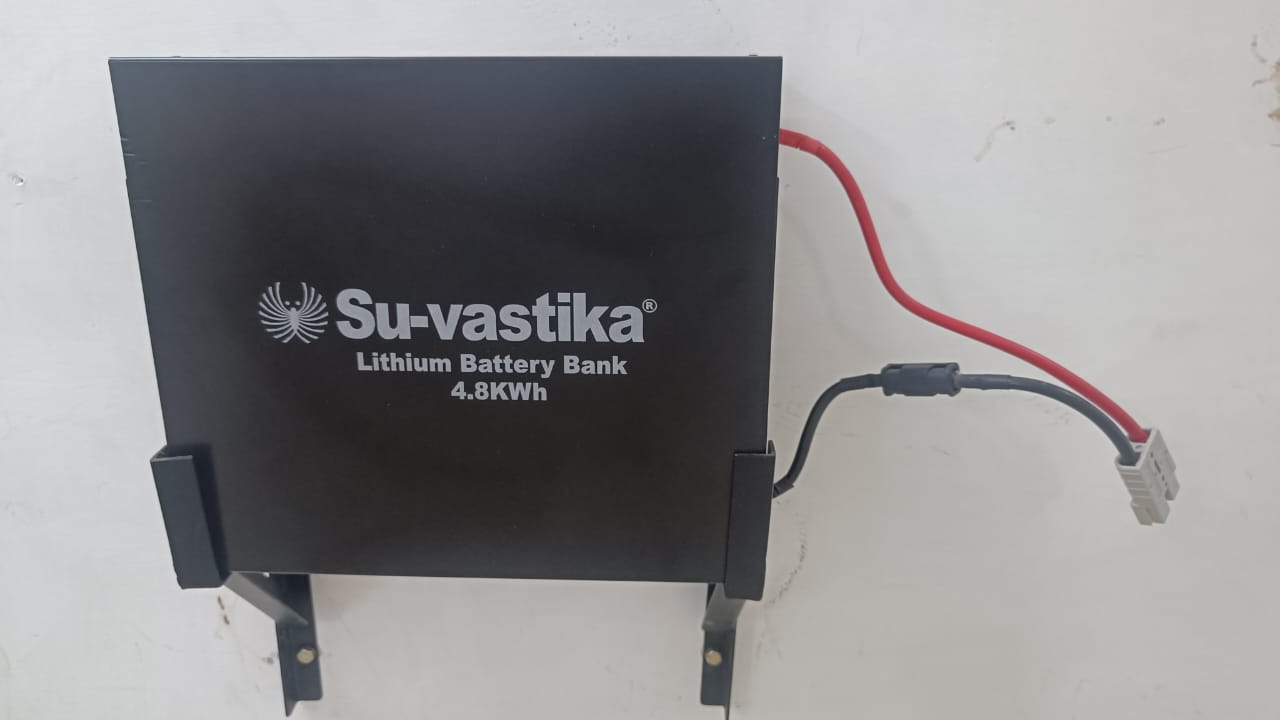
Suvastika Lithium battery

Energy Density: Energy density refers to how much energy a battery can store in a given amount of space (volume) or weight. It’s a measure of how efficient the battery is at packing a punch.

Here’s how lithium and lead-acid batteries compare:

Lithium Ion Batteries:

  • High Energy Density: Lithium-ion batteries boast a much higher energy density, typically ranging from 250 to 670 Wh/L (Watt-hours per Liter). This means a lithium-ion battery can store a significant amount of energy in a relatively small and lightweight package.

Lead-Acid Batteries:

  • Lower Energy Density: Lead-acid batteries, in contrast, have a much lower energy density, typically in the range of 30 to 50 Wh/L. This translates to needing a larger and heavier battery to store the same amount of energy as a lithium-ion battery.
Why are lithium batteries better than lead-acid?

Portability: Since lithium-ion batteries store more energy in a smaller space, they’re perfect for powering portable electronics like laptops, phones, and cameras.

Electric Vehicles: The high energy density allows electric vehicles equipped with lithium-ion batteries to travel longer distances on a single charge compared to those using lead-acid batteries.

Weight: For the same amount of energy storage, lithium batteries weigh considerably less than lead-acid batteries. This makes them ideal for applications where weight is a major concern, like electric vehicles and portable electronics.

Charging Speed: Charging speed is a big advantage for lithium batteries over lead-acid batteries. Here’s a breakdown of why:

Lithium-ion Batteries:

  • Faster Charging: Lithium-ion batteries can generally accept a higher charge rate compared to lead-acid batteries. This means they can reach a full charge much quicker. Think hours for lithium-ion batteries compared to potentially 8 hours or more for lead-acid.
  • Lithium Chemistry: The internal chemistry of lithium-ion batteries allows for faster movement of ions during charging, leading to quicker energy intake.

Lead-Acid Batteries:

  • Slower Charging: Lead-acid batteries require a slower and more controlled charging process. Forcing a faster charge can damage the battery and shorten its lifespan.
  • Crystallization Risk: During rapid charging, lead sulfate crystals can form on the lead plates within the battery. This can hinder its ability to store energy effectively.

Here’s what faster charging with lithium-ion batteries means in practical terms:

  • Convenience: You can recharge your phone or laptop in a shorter amount of time, keeping you connected and productive.
  • Electric Vehicles: Electric vehicles with lithium-ion batteries can be refueled (charged) much faster than those with lead-acid batteries, reducing downtime at charging stations.

Some additional points to consider:

  • Specific charging times can vary depending on the size and capacity of the battery, as well as the charger’s capabilities.
  • While lithium-ion batteries can handle faster charging, some manufacturers recommend slower charging rates to maximize battery life.
  • Lifespan: Lithium batteries typically have a longer lifespan than lead-acid batteries. They can go through more charge cycles before needing replacement.
  • Depth of Discharge: Lithium batteries deliver a higher percentage of their stored energy compared to lead-acid batteries. You get more usable power out of a lithium battery before needing a recharge.
  • Constant Power Delivery: Lithium batteries maintain a more consistent voltage output throughout their discharge cycle. Lead-acid batteries tend to weaken as they discharge.

There are some downsides to consider though. Lithium batteries are generally more expensive upfront than lead-acid batteries. Also, they require special care and handling to ensure safety.

Overall, lithium batteries offer superior performance in most applications. Their higher upfront cost can be offset by their longer lifespan and improved efficiency.

The Benefits of Replacing Gensets with Lithium-based BatteryCategoriesBattery

The Benefits of Replacing Gensets with Lithium-based Battery ESS

The Benefits of Replacing Gensets with Lithium-based Battery ESShttps://suvastika.com/category/diesel-generator/The Benefits of Replacing Gensets with Lithium-based Battery, Clean energy solutions are the priority of every Govt, and Su-vastika has always strived to make it happen. Su-vastika is a Government of India-recognized Star Export House in Gurugram, India. The company has recently announced the launch of its Electronic Genset, which is dubbed “Power on Wheels.” 

It is a pollution-free and much more cost-effective replacement for traditional diesel generators.

The company has installed its electronic genset in their Gurugram-based manufacturing facility as a real-life example, where it is successfully powering the entire factory. The installed electronic genset, which also serves as the best demo for the intended purpose, successfully runs loads of 100 KVA, including capacitive, resistive, and mixed loads.

One of the key features of Su-vastika’s Electronic Genset is its customization capabilities. The capacity can be increased or decreased per the individual’s needs. Even after the installation, the duration of its Electronic Genset can be increased or decreased by reducing the load or increasing the battery capacity. The lithium battery gets charged in 4 to 5 hours completely, so in case of intermittent power cuts, it charges quickly and is ready to give back up again.

Because Su-vastika’s Electronic Genset uses reliable and proven Lithium batteries, the life cycle of the battery is expected to last for 5 to 7 years, depending on the power cuts.

This Electronic Genset is super-clean, with no hanging wires It is completely safe, as there is no inflammable diesel to deal with or worry about electric shocks. It not only looks good but takes much less space which makes it suitable for even the tightest of corners.

https://lithiuminverter.in/uncategorized/advantages-and-disadvantages-li-battery-vs-tubular-battery-using-a-48v-solar-power-conditioning-unit-pcu-with-a-lithium-battery-compared-to-a-tubular-battery/

The Benefits of Replacing Gensets with Lithium-based Battery

Users can simply plug in and forget.  Su-vastika Electronic Genset can easily handle all your power needs for over a decade.

Over time, Suvastika’s Electronic Genset will be much more cost-effective than a diesel generator. 

Because no matter the load, a diesel generator will always use a set amount of fuel, while our Electronic Genset reduces the consumption when the load is decreased. Running on electricity charges takes one-fourth of the cost compared to diesel pricing for running the same load. With no maintenance required, it will keep adding to the savings for years.

This system can run on the solar as well by adding an MPPT Solar charge controller with the solar panels, and this system is designed to add Solar without making any changes in the system.

Su-vastika’s Electronic Genset will undoubtedly bring a massive shift in how we generate and store power. 

Lithium Batteries are Now Cheaper than Tubular BatteriesCategoriesBattery

Lithium Batteries are Now Cheaper than Tubular Batteries

Lithium Batteries are Now Cheaper than Tubular Batteries

Lithium Batteries are Now Cheaper than Tubular Batteries, Lead-acid and lithium batteries are two of the most common types of batteries today.

They have different advantages and disadvantages, so the best type of battery for you will depend on your specific needs.

The Benefits of Replacing Gensets with Lithium-based Battery ESS

Lead-acid batteries are typically less expensive than lithium batteries.

However, the cost of lithium batteries has been declining in recent years, and they are becoming more affordable.

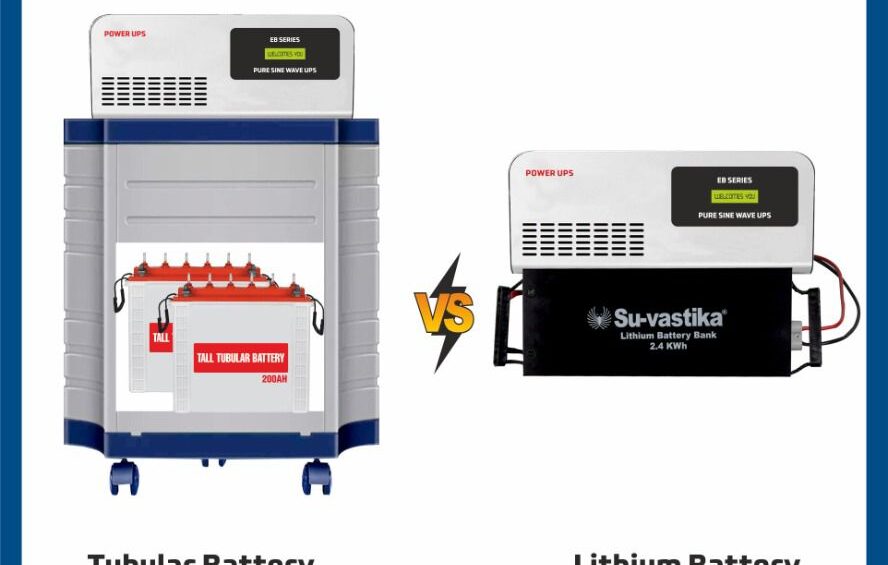
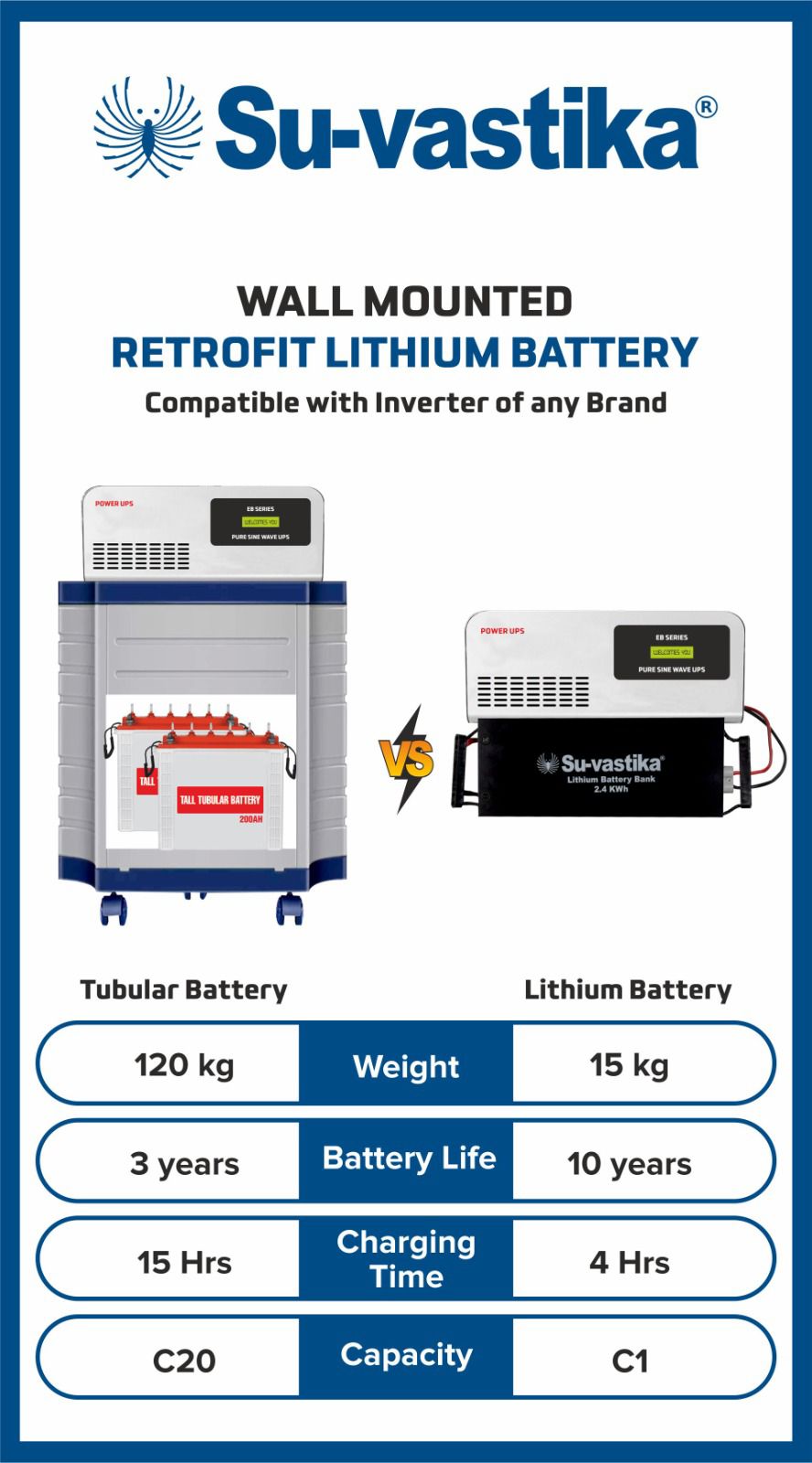
The lead Acid battery comes with a C20 capacity, and Lithium Battery comes with a C1 or C3 capacity.

So there is no match between Lead Acid and Lithium battery as per capacity at discharge level.

As Tubular Lead Acid battery is the most acceptable battery in Inverter, UPS and solar System applications .

So it’s imperative to compare these two technologies and give the proper perspective to the consumer.

So to run the higher load, like 1000 Watt for 12-volt Inverter/UPS or solar PCU application, draws 83 Amp from the lead Acid battery.

Hence, the 200Ah Tubular battery becomes a 60 Ah battery, if the 83 aamp current is drawn.

So we just need 70 Ah lithium battery to get the more back up compare to 200 Ah Tubular battery.

So if we compare the cost of Lithium LifePo4 battery and Tubular lead Acid battery of these two sizes.

We realize the Lithium battery price of 70 Ah is lesser than Tubular battery price of 200 Ah

So we have to compare Lithium batteries Vs Tubular Lead Acid batteries.

https://suvastika.com/lithium-battery-is-cheaper-than-tubular-battery-in-ups-inverter-usage/#:~:text=So%2C%20if%20we%20compare%20the,battery%20price%20of%20200%20Ah.&text=One%20must%20understand%20the%20backup,Acid%20batteries%20are%20obsolete%20today.

Lithium Batteries are Now Cheaper than Tubular Batteries

Lithium Batteries are Now Cheaper than Tubular Batteries

Lithium Batteries are Now Cheaper than Tubular Batteries

One must understand the backup time calculations done on Peukert’s Law for Lead Acid batteries is obsolete today.

So far, the manufacturers and dealer distributors have not made any chart that Tubular Lead Acid battery performance at higher Loads discharge.

Weight and volume

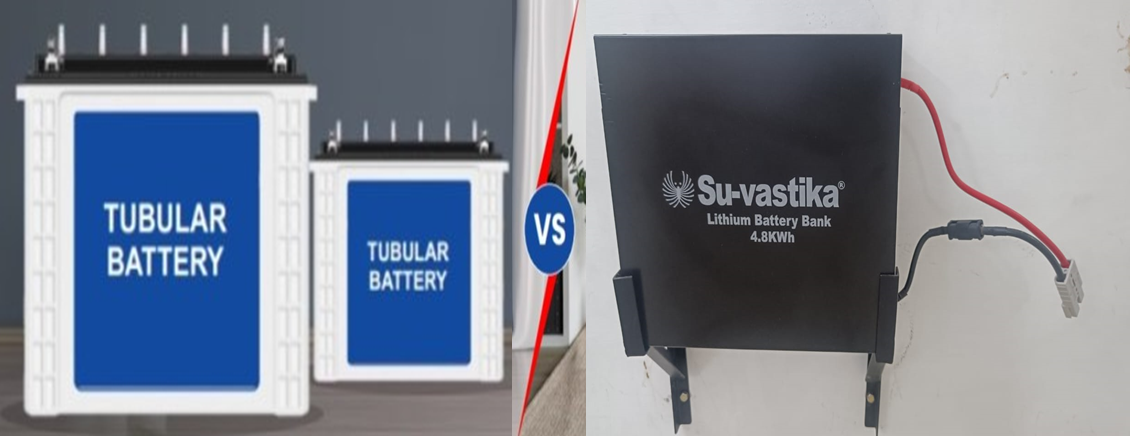
Lead-acid batteries are no comparison as a 200 Ah Tubular battery is 60 kg and a 70 Ah lithium battery of 12.8 v is not even 6 kg in weight.

Energy density

Lithium batteries have a higher energy density than lead-acid batteries. Lithium batteries can store more energy in a given volume or weight.

Charging time

Lithium batteries can be charged in 2 hours, and Tubular batteries take a minimum of 15 hours to be completely charged.

So Lithium batteries can give five times back up in a day if there are intermittent power cuts.

Where as the tubular batteries will not be able to give two times back up in a day.

Cycle life

Lithium batteries have four times the life of tubular batteries. the Lithium battery comes with a Digital Warranty of 3 years.

Operating temperature range

Lithium batteries have a narrower operating temperature range than lead-acid batteries. This means that lithium batteries are less tolerant of extreme temperatures.

Safety

Lead-acid batteries are less safe than lithium batteries. This is because lead-acid batteries can release lead fumes when charged or discharged for any home or office, which should be avoided as Lead has been banned in most areas.

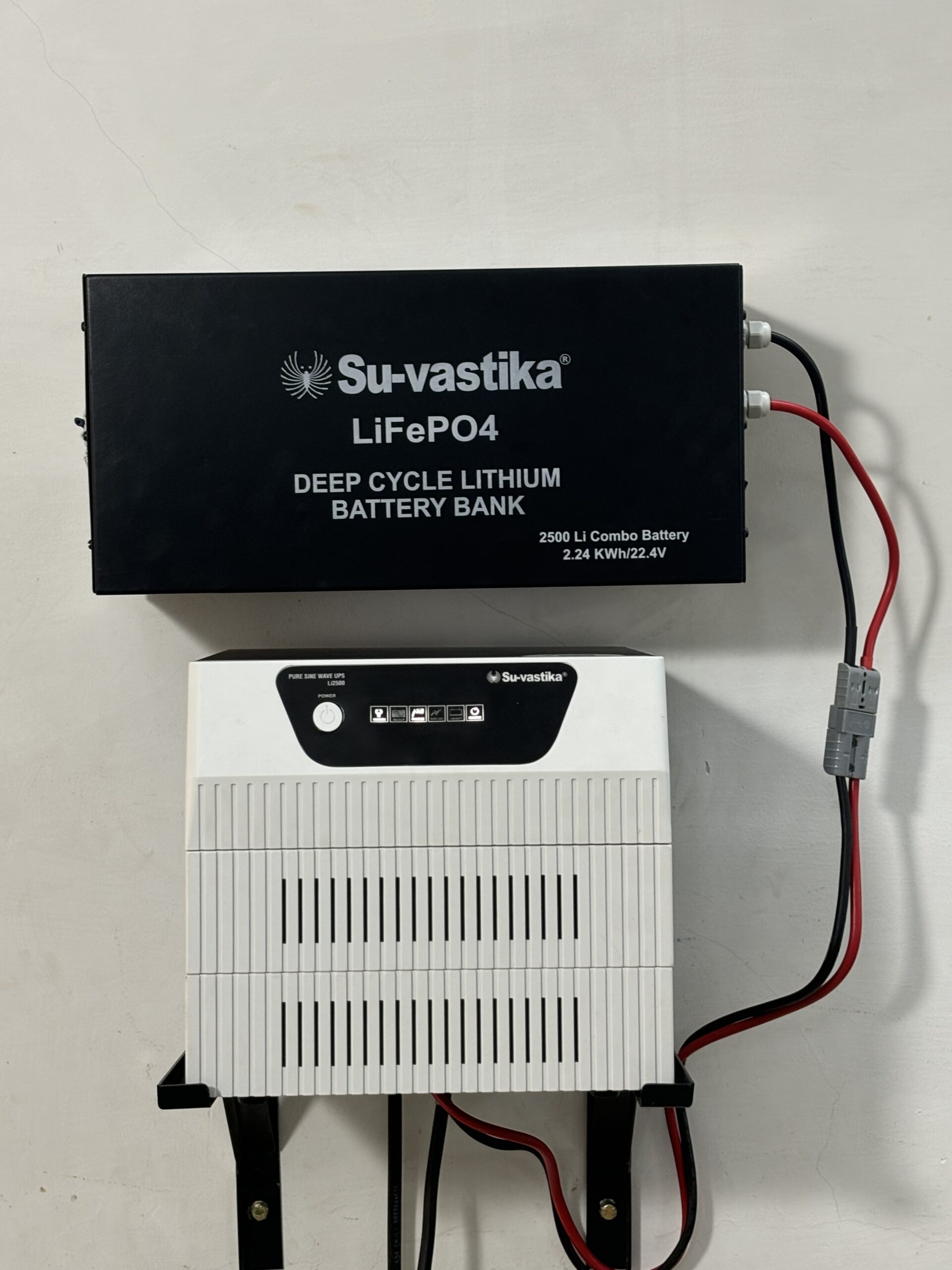
We have kept the provision in our few models for Tubular and Lithium LifePO4 batteries. The user can select which battery to install as per his knowledge and understanding.

Tubular batteries Vs Lithium Baterries

Lithium Batteries are Now Cheaper than Tubular Batteries

Lithium Batteries are Now Cheaper than Tubular Batteries

Maintenance Tubular lead acid battery needs distilled water topping once in 3 to 6 months, which is such a big headache for the user to get the distilled water and refill in time. After the refill, the acid comes out on the floor, which destroys the marble floor also.

Overall

Lithium batteries have several advantages over lead-acid batteries, including higher energy density, longer cycle life, and faster charging time. However, lithium batteries are also more expensive and have a narrower operating temperature range. The best type of battery for you will depend on your specific needs and budget.

Here are some additional considerations when choosing between lead-acid and lithium batteries:

  • Application: If you need a battery for a high-performance application, such as to run higher loads like fridges, geysers Airconditioners, Laser printers, CNC Machinery, microwave ovens, Coffee machines etc., but if you want to run small loads of house like fans LEd lights and TV etc. than the Lead Acid can be a choice but refilling the water and space taken is a big challenge.
  • Price Point: if one sees all these benefits and comparisons, one can realize that a Lithium battery LifePO4 is cheaper than a Tubular lead Acid battery.
  • Operating environment: A lithium battery is a better choice if you live in an area with extreme temperatures. Lead-acid batteries are not as tolerant of extreme temperatures. They need ATC features in the UPS.
Top 5 Inverters Trending in IndiaCategoriesInverter

Top 5 Inverters Trending in India

Top 5 Inverters Trending in India

  1. Luminous Inverter
  2. MICROTEK Inverter
  3. Exide Inverter
  4. Su-vastika Inverter
  5. Amaron Inverter

1. Luminous Inverter

Luminous continues to rule the Home UPS market and the data shows it takes a clear lead in 2016. So, Luminous is the most searched inverter in India (2014 to 2016).

This company’s flagship inverter model is “Luminous Zelio”

Top 5 Inverters Trending in India

2. Microtek Inverter

Microtek comes second to Luminous. By the end of 2015, Microtek Inverter held the No.1 position for a few months, but Luminous took it back in 2016. Aggressive marketing and a wide service network throughout the country help Microtek to hold its position tight.

Top 5 Inverters Trending in India

3. Exide Inverter

Battery manufacturing giant Exide is strongly making its way into the UPS market and now holds the third position in the most searched inverter on the internet.

Though Exide is very popular in the battery segment, the company is just five years old in making inverters. Now Exide is gaining popularity in the Home UPS segment, the chart shows the popularity of Exide Inverters in India.

Using its phenomenal battery dealer network, Exide is easily pushing its inverters into the market.

 Top 5 Inverters Trending in India

4. Su-vastika Inverter

Su-vastika, one of the leading UPS manufacturers in India, holds the fourth position in the most searched inverter in India.

They continuously upgrade their products and release new models every year.


Top 5 Inverters Trending in India

The first Indian start-up to get Technology Patents in the field of Battery Energy Storage Systems(BESS)Su-vastika itself is promoting its products: Its website highlights its inverter and lithium battery storage solutions and even mentions its founder being a well-known figure in the Indian inverter industry (https://suvastika.com/)

To get a better understanding of Su-vastika’s trend in India, here’s what you can do:

  • Look for independent reviews and comparisons of Su-vastika inverters with other popular brands.

  • Check industry reports or news articles mentioning Su-vastika’s performance in the Indian market.

  • Search social media platforms to see if there’s any buzz or discussion around Su-vastika inverters.

  • Overall, while Su-vastika might be showing signs of promise, it’s advisable to do some additional research before considering them a top trending product in India.

    Top 5 Inverters Trending in India

    5. Amaron Inverter

    Top 5 Inverters Trending in India, Amaron Home UPS has become popular in the last two years. Amaron is popular in the battery segment and they are using their battery dealer network to promote their Home UPS.

    Surprisingly, Amaron beats APC Inverter and holds the fifth position in the list of “most searched inverters in India”

    Why Choose Lithium Battery Banks over Lead-Acid Batteries?CategoriesBattery

    Why Choose Lithium Battery Banks over Lead-Acid Batteries?

    Why Choose Lithium Battery Banks over Lead-Acid Batteries? Lithium battery banks offer several advantages over sealed lead-acid (SLA) batteries commonly used in Suvastika’s UPS systems.

  • Increased runtime: Lithium batteries provide longer backup power during outages due to their higher energy density compared to SLA batteries.

  • Lighter weight and smaller footprint: Lithium batteries are much lighter and more compact than SLA batteries. “These items are perfect for situations where there is limited space or when portability is essential.”.

  • Faster charging: Lithium batteries can recharge much faster than SLA batteries, minimizing downtime after a power outage.

  • Longer lifespan: Lithium batteries typically last 7-10 years, whereas SLA batteries only have a lifespan of 2-3 years. This translates to significant cost savings in the long run.

  • Lower maintenance: Unlike SLA batteries, lithium batteries require no maintenance, such as topping up water or checking acid levels.


  • https://lithiuminverter.in/inverter/advantages-and-disadvantages-li-battery-vs-tubular-battery-using-a-48v-solar-power-conditioning-unit-pcu-with-a-lithium-battery-compared-to-a-tubular-battery/?


    Why Choose Lithium Battery Banks over Lead-Acid Batteries?


    Suvastika specifically mentions their Lithium Ion Battery Bank with a Battery Management System (BMS) that offers additional benefits:


    • Faster charging and discharging: As mentioned earlier, lithium batteries excel in charging speed.

    • IoT features: The BMS allows you to monitor and control battery parameters through a mobile app via Bluetooth and Wi-Fi.

    • Lower self-discharge rate: Lithium batteries hold their charge for longer periods when not in use.


    Why Choose Lithium Battery Banks over Lead-Acid Batteries?


    Why Choose Lithium Battery Banks over Lead-Acid Batteries?


    Overall, lithium battery banks provide a more reliable, efficient, and user-friendly experience for Suvastika’s UPS systems


    Su-vastika has developed a unique lithium-ion battery bank that promises to revolutionize the battery industry and the electric vehicle industry. Our lithium battery bank is highly compatible and visually appealing, surpassing tubular or lead-acid batteries of the same capacity.

    One of the most important things in any lithium battery bank is BMS (Battery Management System).

    Typically, local Lithium battery banks lack a Battery Management System (BMS). As a result, the lithium battery cells become unbalanced and can lead to battery bank failure, which can be disastrous. Keeping these things in mind we at Su-vastika developed our Lithium battery bank with inbuilt BMS which not only keeps the battery healthy but also maintains the temperature, charging current, and voltage range so that the battery bank will operate safely. Also, BMS monitors the charging and discharging cycle of each cell so that battery cells will not get damaged.

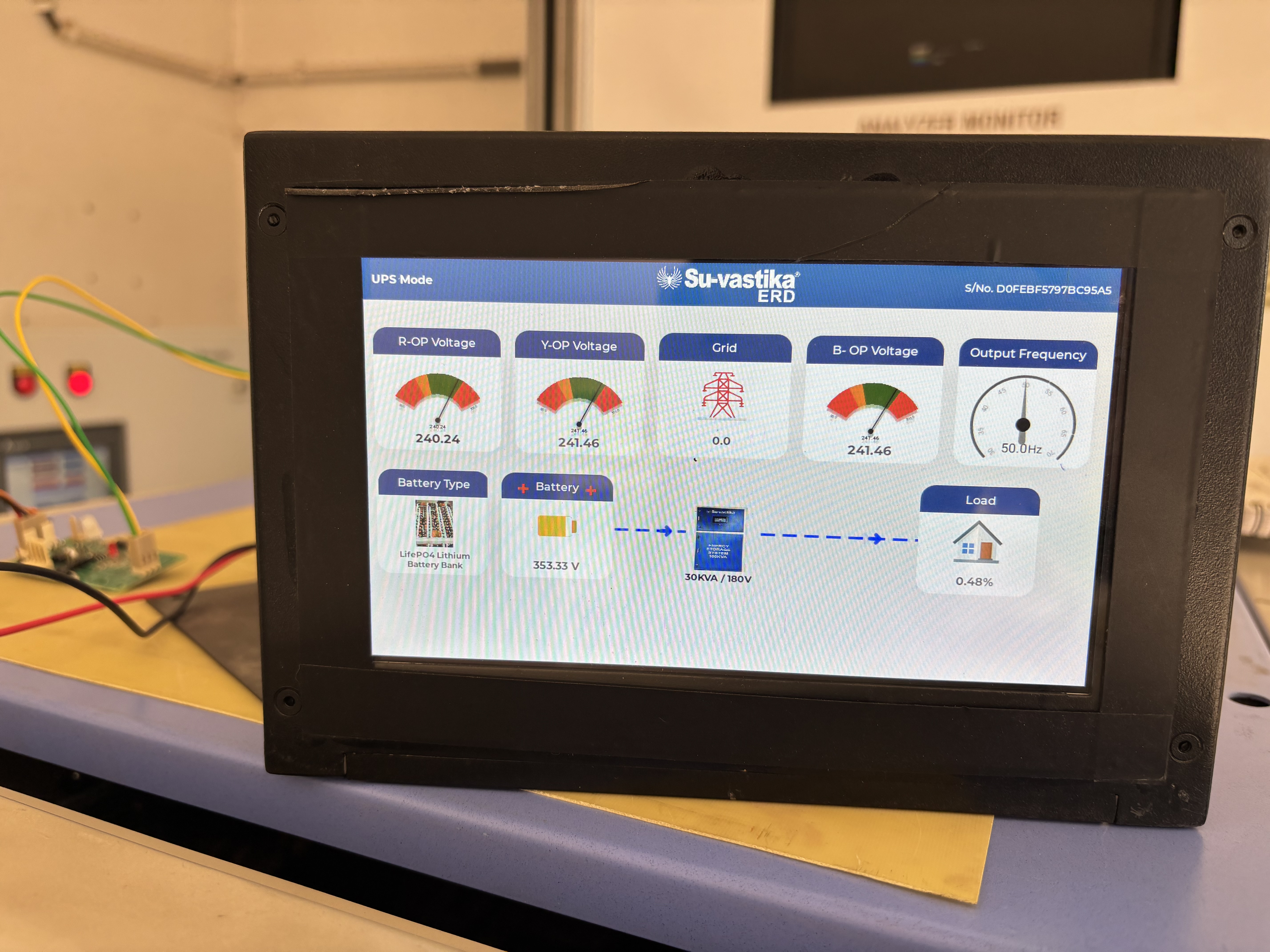
    Our Lithium battery bank has its own dedicated LCD which shows every parameter of the battery bank like battery bank details, each cell voltage level, warranty details, and discharging current. Typically, local Lithium battery banks lack a Battery Management System (BMS). As a result, the lithium battery cells become unbalanced and can lead to battery bank failure, which can be disastrous.

    We will be adding a Wi-Fi feature to our lithium battery bank, along with the optional GPS, for remote monitoring. This will ensure that battery swapping is a smooth process and customers are aware of its status. The seller can also track the battery’s place and status for better after-sale service issues. Lithium battery is an important area of technology where the focus is to develop the BMS (Battery Management System) that defines the life and the best output of the Lithium cells.

    We have created new technologies in this field and are continuously filing patents in this area. More and more technology patents are emerging as we are sure to capture the E-Vehicle market in the next 2 to 5 years by using our Lithium battery technology.

    The major challenge faced by the electric vehicle industry is lithium batteries and their charging techniques. We are working on manufacturing Lithium lifP04 batteries In-house, for which In-house BMS and In-house manufacturing capabilities are being created. Also working on high-capacity battery banks is the future for the high-capacity UPS and big Solar Projects.

    We have already filed patents for the same. Lithium battery technology is bringing the revolution in the Heavy duty UPS (3Phase) as it will replace the Heavy Duty 3-Phase Generators because the cost of running it, is much cheaper and it can be easily maintained without getting the oil refueling and maintenance.

    Why Choose Lithium Battery Banks over Lead-Acid Batteries?

    Why Choose Lithium Battery Banks over Lead-Acid Batteries?

    Kunwar Sachdeva is a prominent figure in the Indian power backup industry, but his influence extends beyond just legacy technologies.

    There’s no doubt that Kunwar Sachdeva, through Suvastika, is actively involved in promoting Lithium Ion Battery solutions and integrating them with inverters and solar systems

    https://suvastika.com/new/wp-content/uploads/2024/02/COMBO-SOLAR-HYBRID-PCU-Rev.-02-1.pdf

    The Lifespan of Lithium vs. Lead Acid Battery: A Comparative StudyCategoriesTechnology Blogs

    The Lifespan of Lithium vs. Lead Acid Battery: A Comparative Study

    The Lifespan of Lithium vs. Lead Acid: A Comparative Study

    The Lifespan of Lithium vs. Lead Acid Battery: A Comparative Study, This study compares the lifespan of lithium and lead-acid batteries, two common battery technologies used in various applications, including inverters, solar power systems, and electronic devices.

    The Lifespan of Lithium vs. Lead Acid: A Comparative Study

    Lithium Inverter: A lithium inverter can last for over 10 years, but its functionality is dependent on the battery it’s connected to and the conditions it’s exposed to.

    Lithium inverters have several advantages over those that use traditional sealed lead-acid (SLA) batteries. Here’s a breakdown of the key benefits:What is the life of lithium compared to a Lead Acid battery Lifespan Definition Battery lifespan refers to the total duration a battery can deliver its intended performance before needing replacement. It’s typically measured in years or the number of charge-discharge cycles the battery can withstand before falling below a specific capacity threshold (often 80% of its original capacity).Lithium vs. Lead Acid Battery Lifespan

    Lithium Batteries:
    Lifespan: 7-10 years or 3000-5000 cycles (depending on factors like depth of discharge)The Lifespan of Lithium vs. Lead Acid: A Comparative Study
    Advantages:

    • Longer lifespan compared to lead-acid batteries, leading to fewer replacements and lower overall costs in the long run.
    • Less capacity degradation with each cycle, allowing for more consistent performance throughout its lifespan.
    • Deeper discharge tolerance (around 80%) without significant lifespan reduction, providing more usable backup power.

    The Lifespan of Lithium vs. Lead Acid: A Comparative Study

    • Depth of discharge: Lithium batteries can be discharged much deeper (around 80%) without harming their capacity. In contrast, discharging SLA batteries beyond 50% can shorten their lifespan. This allows lithium inverters to provide more backup power during outages.
    • Faster charging: Lithium batteries recharge much faster than SLA batteries, minimizing downtime after a power cut. This is crucial for situations where you rely heavily on backup power.
    • Lower maintenance: Unlike SLA batteries, lithium batteries require minimal maintenance. You won’t need to worry about topping up water or checking acid levels.

    The Lifespan of Lithium vs. Lead Acid: A Comparative Study

    Tubular Lead Acid Battery: Tubular lead acid batteries, while a popular choice for inverter systems, come with some drawbacks compared to newer lithium battery technology, These batteries typically have a lifespan of 2-3 years. Their capacity degrades with each charge/discharge cycle, and deep discharges significantly shorten their life.

    • Lifespan: 2-3 years or 300-500 cycles (depending on factors like depth of discharge)
    • Disadvantages:
      • Shorter lifespan compared to lithium batteries, requiring more frequent replacements and higher overall costs.
      • Higher capacity degradation with each cycle leads to a faster decline in performance.
      • Limited depth of discharge (around 50%) to maintain lifespan, reducing usable backup power.
    The Lifespan of Lithium vs. Lead Acid Battery: A Comparative Study
    The Lifespan of Lithium vs. Lead Acid Battery: A Comparative Study

    Limited Depth of Discharge: Deep discharging (below 50%) can significantly shorten a tubular battery’s lifespan. This limits the usable capacity of the battery during an outage.
    Slower charging: Tubular batteries take longer to recharge than lithium batteries, increasing downtime after a power cut.

    Maintenance requirements: Unlike lithium batteries, tubular batteries require regular maintenance, such as topping up with distilled water and cleaning the terminals. Neglecting this maintenance can lead to reduced performance and a shorter lifespan.

    Weight and size: Tubular batteries are much heavier and bulkier than lithium batteries for the same energy storage capacity. This can be a disadvantage for space-constrained applications.

    Environmental impact: Lead is a toxic material, and improper disposal of tubular batteries can pose environmental hazards. Additionally, they vent hydrogen gas during operation, which requires proper ventilation.

    Temperature: Extreme temperatures (hot or cold) can accelerate capacity degradation and reduce lifespan for both battery types.

    Charging habits: Using fast charging constantly or keeping the battery at very high or low charge levels can reduce lifespan for both types.

    The Lifespan of Lithium vs. Lead Acid: A Comparative Study

    ComponentLifespanLithium Inverter10+ yearsTubular Lead-Acid Battery2-3 yearsLithium Battery (used with Lithium Inverter)7-10 years

    The Lifespan of Lithium vs. Lead Acid: A Comparative Study

    Overall:

    A lithium inverter paired with a lithium battery will provide significantly longer backup power and overall system life compared to a setup using a tubular lead acid battery.

    Here are some additional points to consider:

    Lithium Battery Cycles:

    Lithium battery cycles refer to the complete process of discharging a lithium battery, and then recharging it back to full capacity. This cycle repeats throughout the battery’s lifespan, but with each cycle, the battery’s capacity to hold a charge gradually decreases. Here’s a breakdown of key points about lithium battery cycles:
    Impact on lifespan: The number of cycles a lithium battery can endure significantly impacts its lifespan. Most lithium batteries used in inverters and electronic devices are rated for 300 to 500 cycles before dropping below 80% of their original capacity.
    Depth of discharge: The depth of discharge (DOD) refers to how much of a battery’s capacity is used before recharging. Shorter discharge cycles (using less of the capacity) contribute to a longer lifespan. For example, discharging a battery to 50% and then recharging it counts as half a cycle.

    Factors affecting cycles: Several factors can influence the number of cycles a lithium battery experiences:

    • Depth of discharge: As mentioned earlier, shallower discharges contribute to more cycles.
    • Temperature: Extreme temperatures, both hot and cold, can accelerate capacity degradation and reduce cycle life.
    • Charging habits: Constantly using fast charging or keeping the battery at very high or low charge levels can also reduce cycles.

    The Lifespan of Lithium vs. Lead Acid: A Comparative Study Here are some things to consider to maximize the number of cycles in your lithium battery:

    Avoid full discharges: Try not to completely drain your battery before recharging. Ideally, stay between 20% and 80% charge level for most cycles.

    Use proper chargers: Always use the charger recommended by the manufacturer to avoid damaging the battery.

    Maintain moderate temperatures: Avoid exposing your battery to extreme heat or cold.

    Shallow discharges preferred: Whenever possible, perform shorter discharge cycles and recharge more frequently.

    By following these practices, you can optimize the number of cycles your lithium battery goes through and extend its overall lifespan.

    Depth of Discharge: Lithium batteries can be discharged deeper (around 80%) without harming their capacity, unlike tubular batteries which are limited to around 50% depth of discharge.

    Maintenance: Lithium batteries require minimal maintenance, while tubular batteries need regular topping up of distilled water.

    Key Takeaways lithium batteries offer a significantly longer lifespan compared to lead-acid batteries, making them a more cost-effective choice in the long run. Lithium batteries can be discharged deeper without impacting their lifespan as much as lead-acid batteries, providing more usable backup power. Both lithium and lead-acid batteries benefit from practices that minimize the depth of discharge, avoid extreme temperatures, and use proper charging methods.

    The Lifespan of Lithium vs. Lead Acid: A Comparative StudyIn conclusion, while the inverter itself might have a similar lifespan regardless of the battery type, the choice of battery significantly impacts the overall system’s life expectancy and performance. Lithium batteries offer a clear advantage in terms of lifespan and reliability.https://suvastika.com/lithium-inbuilt-battery-ess-2500/

    The Rise of India as the Export Hub for Lithium InvertersCategoriesInverter News

    The Rise of India as the Export Hub for Lithium Inverters

    India will be the hub for exports in Lithium Inverters:The Rise of India as the Export Hub for Lithium Inverters, with ongoing research and development, lithium technology is poised to play an even greater role in the future, contributing to advancements in clean energy, portable electronics, electric vehicles, and more sustainable energy storage solutions.https://lithiuminverter.in/battery/lithium-batteries-are-now-cheaper-than-tubular-batteries/?Driving Forces:
  • Solar Power Boom: India’s domestic solar power market is experiencing rapid growth. This creates a high demand for lithium-ion batteries for energy storage, which are frequently paired with inverters in solar power systems.

  • Government Support: The Indian government is actively promoting clean energy and battery manufacturing through policies and incentives. This fosters an environment conducive to domestic lithium inverter production.

  • Skilled Workforce: India boasts a large pool of skilled engineers and technicians who can contribute to the research, development, and manufacturing of lithium inverters.

  • Challenges to Overcome:

  • Lithium Dependence: India currently lacks significant lithium reserves, meaning it relies heavily on imports for battery production. This can be a hurdle in large-scale, cost-effective lithium inverter production.

  • Competition: China is the current global leader in lithium battery and inverter manufacturing. India needs to establish a strong production base and competitive edge to become a major exporter.

  • There are many lithium inverters made in India.


    Lithium Technology Focus: There’s no doubt that Kunwar Sachdev, through Suvastika (his current venture after Su-Kam), is actively involved in promoting Lithium Ion Battery solutions and integrating them with inverters and solar


    Lithium technology is rapidly growing in importance across various industries due to its unique properties. Here’s a breakdown of its key aspects and areas of focus:


    Why Lithium?


    Lithium, the lightest metal, offers several advantages that make it ideal for battery applications:

  • High Energy Density: Lithium batteries can store more energy per unit weight or volume compared to other battery technologies, making them perfect for portable electronics and electric vehicles.

  • Long Lifespan: Lithium batteries boast a longer lifespan than traditional batteries like lead-acid, requiring fewer replacements and offering lower long-term costs.

  • Fast Charging: Lithium batteries can recharge much faster than other battery types, minimizing downtime for devices or power backup systems.

  • Low Maintenance: Lithium batteries require minimal maintenance compared to other battery technologies.


  • The Rise of India as the Export Hub for Lithium Inverters


    Focus Areas in Lithium Technology:

  • Battery Material Research: Scientists are constantly researching new electrode materials (anode and cathode) to improve energy density, lifespan, and charging speeds of lithium batteries.

  • Safety Enhancements: While generally safe, lithium batteries can pose thermal runaway risks under extreme conditions. Research is ongoing to develop even safer electrolytes and cell designs.

  • Recycling and Sustainability: Developing efficient and eco-friendly methods for recycling lithium batteries is crucial for a sustainable future with this technology.

  • Cost Reduction: While lithium batteries are becoming more affordable, research is directed towards lowering production costs to make them even more accessible.

  • Solid-State Battery Development: Solid-state batteries offer potential advantages like higher energy density and improved safety. This is a significant area of research and development.

  • Applications of Lithium Technology:

  • Consumer Electronics: Lithium batteries power laptops, smartphones, tablets, cameras, and many other portable devices.

  • Electric Vehicles: Lithium-ion batteries are the dominant technology for electric vehicles (EVs) due to their range and performance capabilities.

  • Energy Storage: Large-scale lithium battery systems are used for grid energy storage, enabling the integration of renewable energy sources like solar and wind.

  • Power Backup Systems: Lithium batteries are increasingly used in inverters for home and commercial backup power, offering longer runtime and higher efficiency than traditional lead-acid batteries.

  • The Rise of India as the Export Hub for Lithium Inverters


    Challenges to Overcome:


    • Lithium Dependence: India currently lacks significant lithium reserves, meaning it relies heavily on imports for battery production. This dependence can make it difficult to compete with countries like China who have more readily available lithium resources, potentially increasing production costs.

    • Competition: China is the current global leader in lithium battery and inverter manufacturing. India needs to establish a strong production base, ensure quality, and potentially find ways to reduce production costs to become a major exporter.
  • The Future of Lithium Technology:

    The Rise of India as the Export Hub for Lithium Inverters, Inverter Man of India Kunwar Sachdev is leading the way in lithium inverter technology through his current venture, Su-vastika. Su-vastika focuses on developing Lithium-ion battery solutions and integrating them with inverters and solar systems. This demonstrates his forward-thinking approach and recognition of the potential of lithium technology in the inverter industry. Some of the major manufacturers of lithium inverters in India:


    1. Exide Industries

    2. Luminous Power Technologies

    3. Microtek Inverters

    4. Su-vastika Systems Pvt. Ltd.

    5. Genus Power Infrastructures

    6. Waaree Energies

    7. Delta Electronics India

    8. Konica Minolta India

    9. Livfast Industries

    10. Oxy Neuron India

      The Rise of India as the Export Hub for Lithium InvertersThese companies manufacture a variety of lithium inverters, including solar inverters, UPS inverters, and home inverters. Lithium inverters are becoming increasingly popular in India due to their many advantages, such as their long lifespan, high efficiency, and lightweight design.

    As the hub of exports in the inverter industry, India is well-positioned to become a significant manufacturer of lithium inverters. The country has many advantages, such as a large pool of skilled labor, a well-developed manufacturing infrastructure, and access to raw materials. In addition, the Indian government is supporting the lithium inverter industry by providing subsidies and tax breaks to manufacturers.

    As a result of these factors, the Indian lithium inverter industry is expected to multiply in the coming years. This growth will create new opportunities for Indian companies to export products to other countries.The Rise of India as the Export Hub for Lithium InvertersIndia has the potential to be a major exporter of lithium inverters, but it needs to overcome certain challenges. Kunwar Sachdev plays a vital role in driving the adoption of lithium inverter technology in India through his company, Su-vastika.https://suvastika.com/benefits-of-lithium-battery-in-inverter-ups/

    Proper Disposal of Lithium-Ion Batteries: Options in IndiaCategoriesTechnology Blogs

    Proper Disposal of Lithium-Ion Batteries: Options in India

    Proper Disposal of Lithium-Ion Batteries: Options in India

    1. Authorized Collection Centers:

    • Many electronics manufacturers and retailers offer take-back programs for lithium-ion batteries. Contact the manufacturer of your device or local retailers like Amazon, Flipkart, or Croma to inquire about battery recycling options.
    • Look for stores with collection bins specifically designated for lithium-ion batteries.

    2. E-waste Recycling Facilities:

    E-waste recycling facilities process electronic waste, including lithium-ion batteries, to ensure environmentally responsible disposal and recover valuable resources.

    Here’s how to find E-waste recycling facilities in India:

    1. Government Websites:

    • The Indian government agency responsible for regulating e-waste management is the Central Pollution Control Board (CPCB). Their website features a registry of authorized e-waste recyclers across India, allowing you to easily locate facilities in your area.https://cpcb.nic.in/e-governance-portals/

    Proper Disposal of Lithium-Ion Batteries: Options in India

    2. E-waste Management Companies:

    Proper Disposal of Lithium-Ion Batteries: Options in India

    3. Producer Responsibility Organizations (PROs):

    • PROs are organizations established by electronics manufacturers to fulfill their Extended Producer Responsibility (EPR) obligations. These organizations may conduct collection drives or partner with e-waste recycling facilities. To know if any PROs in your area run collection programs, you can visit the websites of major electronics manufacturers in India.

    Proper Disposal of Lithium-Ion Batteries: Options in India

    4. Municipal Programs:

    • Some local governments organize hazardous waste collection drives or drop-off points for lithium-ion batteries. Check your municipality’s website or sanitation department for details.

    Proper Disposal of Lithium-Ion Batteries: Options in India

    Important Considerations:

    • Choose a certified facility: Make sure to select an e-waste recycling facility that is certified by the CPCB or other relevant authorities to ensure compliance with proper environmental and safety standards during the recycling process.
    • Check what they accept: Different e-waste facilities may have varying guidelines on acceptable items. Confirm acceptance of lithium-ion batteries and other electronics.
    • Data security: If you’re disposing of devices that store sensitive data, ask about the facility’s data-wiping procedures to make sure your information is securely erased.

    Proper Disposal of Lithium-Ion Batteries: Options in India

    3. Municipality/Government Programs:

    • Some municipalities and local governments may have programs for collecting hazardous waste, including lithium-ion batteries. Check your local municipality’s website or sanitation department for information.

    Proper Disposal of Lithium-Ion Batteries: Options in India

    Proper Disposal of Lithium-Ion Batteries: Options in India
    Proper Disposal of Lithium-Ion Batteries: Options in India

    Important Tips:

    • Never dispose of lithium-ion batteries in regular trash. They can cause fires or environmental hazards.
    • Pack your batteries securely in a plastic bag or container before transporting them to a collection center.
    • Do not attempt to disassemble or tamper with the batteries.
    • If your battery is damaged or leaking, contact the manufacturer or a hazardous waste disposal specialist for proper handling instructions.

    Proper Disposal of Lithium-Ion Batteries: Options in India

    Remember, proper disposal of lithium-ion batteries is crucial for the environment

    • Local hazardous waste collection centers: Usually, local government or private waste disposal companies operate these centers.
    • Many electronics manufacturers and retailers offer take-back programs for lithium-ion batteries. Contact the manufacturer of your device or local retailers like Amazon, Flipkart, or Croma to inquire about battery recycling options.
    • Look for stores with collection bins specifically designated for lithium-ion batteries.

    Proper Disposal of Lithium-Ion Batteries: Options in India

    • Some electronics retailers: There are several electronics retailers, including Best Buy and Staples, that offer battery recycling programs.
    • Call2Recycle: This is a national battery recycling program that has drop-off locations in most states.

    Proper Disposal of Lithium-Ion Batteries: Options in India

    You can locate hazardous waste collection centers and battery recycling programs in your area by searching online or contacting your local solid waste management department.

    Top 10 lithium battery pack manufacturers from IndiaCategoriesNews

    Top 10 lithium battery pack manufacturers from India

    Find the Top 10 Lithium Battery Pack Manufacturers in India,

    Top 10 lithium battery pack manufacturers from India, Identifying the absolute top 10 lithium battery pack manufacturers in India can be challenging due to the dynamic nature of the industry. However, here are 10 well-regarded lithium battery pack manufacturers in India,

    Top 10 lithium battery pack manufacturers from India

    1. Su-vastika Systems Pvt Ltd: As mentioned earlier, Suvastika Systems focuses on lithium battery-based energy storage solutions, including solar inverters and battery backup systems. Their experience in this domain positions them well in the growing lithium-ion battery market. 

    Top 10 lithium battery pack manufacturers from India
    Top 10 lithium battery pack manufacturers from India

    2. Amara Raja Battery:- Amara Raja doesn’t currently produce Lithium-ion batteries for the mass market, but they are making a big push into this area.

    Top 10 lithium battery pack manufacturers from India

    Amara Raja is a major Indian company that manufactures batteries for a variety of applications. They are one of the strongest lead-acid battery players in India, but they see lithium-ion as the future of battery technology for electric vehicles and other applications.

    Top 10 lithium battery pack manufacturers from India

    Top 10 lithium battery pack manufacturers from India
    Top 10 lithium battery pack manufacturers from India

    3. AMARON:- Amaron is an Indian company leading the way in advanced battery technology in India. While they are known for their high-quality automotive batteries, they are also investing in lithium-ion battery production. They recently opened a lithium-ion cell manufacturing facility at their Tirupati facility in Andhra Pradesh to become India’s first private sector lithium-ion cell manufacturing facility.

    Top 10 lithium battery pack manufacturers from India

    Top 10 lithium battery pack manufacturers from India

    4. Exide Industries Ltd: This well-known automotive battery manufacturer has diversified into lithium-ion batteries for electric vehicles and energy storage applications. They have set up a dedicated lithium-ion battery manufacturing plant near Pune.

    Top 10 lithium battery pack manufacturers from India
    Top 10 lithium battery pack manufacturers from India

    5. Okaya company in India has more than 40 years of history, its charging pile, photovoltaic, electric motor, new energy vehicles and other businesses, is also India’s third largest battery manufacturer, 2022, Okaya’s electric motor sales ranked 6th in the country in 2024, OKAYA new models will use Chenhan intelligent instruments.

    Top 10 lithium battery pack manufacturers from India

    6. Tata Chemical:-  Tata Chemicals has entered into a non-exclusive memorandum of understanding (MOU) with the Vikram Sarabhai Space Centre of the Indian Space Research Organisation (ISRO) for the transfer of the latter’s lithium-ion battery technology. ISRO has been using lithium-ion batteries internally to power its satellites and launch vehicles. Tata Chemicals is reportedly exploring business opportunities related to the import and exploration of lithium from Bolivia.

    Top 10 lithium battery pack manufacturers from India

    7. Loom Solar:- Loom Solar is an Indian company that manufactures solar panels and lithium batteries. It was founded in 2018 by two brothers, Amol and Amod (formerly Schneider, Airtel). The company aims to help homeowners in urban areas reduce their electricity bills, while in small towns, it helps consumers have access to 24X7 power by installing solar panels and energy storage systems on their roofs. Currently, the company supplies electricity to 50,000 homes.

    Top 10 lithium battery pack manufacturers from India

    Top 10 lithium battery pack manufacturers from India

    8. Johnson Controls-Hitachi Automotive Systems Pvt Ltd (JCH): A joint venture between Johnson Controls and Hitachi, JCH manufactures lithium-ion batteries for hybrid and electric vehicles.

    Top 10 lithium battery pack manufacturers from India
    Top 10 lithium battery pack manufacturers from India

    9. Panasonic India Pvt Ltd: A subsidiary of the Japanese electronics giant, Panasonic India, manufactures lithium-ion batteries for a variety of applications, including consumer electronics and power tools.

    Top 10 lithium battery pack manufacturers from India
    Top 10 lithium battery pack manufacturers from India

    10. LG Chem India Pvt Ltd: The Indian arm of the South Korean chemical company, LG Chem, manufactures lithium-ion batteries for electric vehicles and energy storage systems.

    Top 10 lithium battery pack manufacturers from India
    Top 10 lithium battery pack manufacturers from India

    These companies are leading the way in the development and manufacturing of lithium battery packs in India. They offer a wide range of products for different applications, including electric vehicles, solar energy storage, and telecom.

    Find the Top 10 Lithium Battery Pack Manufacturers in India

    Here are some of the factors that contribute to the success of these companies:

    • Strong research and development capabilities
    • Access to raw materials
    • Government support
    • Growing demand for lithium batteries in India

    The Indian lithium battery market is expected to grow rapidly in the coming years. This is due to the increasing demand for electric vehicles, solar energy storage, and telecom. The top 10 lithium battery pack manufacturers from India are well-positioned to capitalize on this growth.Top 10 lithium battery pack manufacturers from India

    Top 10 lithium battery pack manufacturers from India

    Introducing SMA's New Hybrid Inverters for Residential UseCategoriesInverter

    Why Choose a Lithium Inverter? Discover the Advantages

    Why Choose a Lithium Inverter? Discover the Advantages

    Lithium inverters offer longer backup duration and faster recharge times due to their higher energy density and capacity. They can store more energy per unit of weight and size, making them more efficient. Lithium batteries have a slower discharge rate, allowing for longer recharge times. They are also environmentally friendly, as they do not contain lead or produce harmful emissions. However, they are more expensive than lead-acid inverters. While they offer environmental advantages like cleaner power output, longer lifespan, reduced maintenance, and potential for recycling, they also have environmental disadvantages.

    [av_gallery ids=’3417,3441,3440,3416,3415,3414,3413,3412,3411,3410,3409,3408,3407,3406,3405,3403,3397′ style=’thumbnails’ preview_size=’portfolio’ crop_big_preview_thumbnail=’avia-gallery-big-crop-thumb’ thumb_size=’portfolio’ columns=’5′ imagelink=’lightbox’ link_dest=” lightbox_text=’caption’ lazyload=’avia_lazyload’ img_scrset=” html_lazy_loading=’disabled’ alb_description=” id=” custom_class=” template_class=” av_uid=’av-16ipj’ sc_version=’1.0′ admin_preview_bg=”]

    Longer backup power: Lithium batteries have a higher energy density than lead-acid batteries so they can provide more backup power for a given size inverter.
    Faster recharge times: Lithium batteries can be recharged much faster than lead-acid batteries. This means you can restore your backup power more quickly after a power outage.

          1. Higher Capacity:

    • Lithium-ion batteries boast a higher energy density than lead-acid batteries. This means they can store more energy per unit of weight and size. In simpler terms, a Suvastika lithium battery bank can pack more punch in a smaller, lighter package compared to a lead-acid battery bank with the same capacity. This translates to potentially doubling or even tripling your backup power duration for your appliances during outages.

          2. Deeper Discharge:

    • Lead-acid batteries typically shouldn’t be discharged below 50% regularly to maintain a healthy lifespan. Lithium-ion batteries, on the other hand, can often be discharged 80% or more without harming the battery. This means you can utilize a larger portion of the stored energy in your Suvastika lithium battery bank during a power outage, extending your backup power compared to lead-acid systems.

          3. Slower Discharge Rate:

    • Lithium-ion batteries naturally have a lower self-discharge rate compared to lead-acid batteries. This means a fully charged Suvastika lithium battery bank will hold its charge for longer periods when not in use. This is particularly advantageous if you experience infrequent power outages. You’ll have a fully charged battery bank ready when you need it most.

    Environmentally friendly: Lithium batteries do not contain lead, which is a toxic metal. Additionally, lithium batteries do not produce harmful emissions when they are charged or discharged.

    While lithium-ion batteries and inverters offer significant advantages over traditional options, there’s an asterisk when it comes to their eco-friendliness. Here’s a breakdown of the positive and negative aspects:

    1. Environmental Advantages:

    • Cleaner Power Output (Inverter): Compared to generators that burn fossil fuels, inverters with lithium-ion batteries produce clean electricity during power outages. This reduces air pollution and greenhouse gas emissions.
    • Longer Lifespan (Lithium Battery): Lithium-ion batteries typically last 2-3 times longer than lead-acid batteries used in inverters. This reduces the need for frequent replacements and disposal of old batteries, lowering the overall environmental impact.
    • Reduced Maintenance (Lithium Battery): Unlike lead-acid batteries, lithium-ion batteries require no regular maintenance like topping up electrolytes. This eliminates the need for disposal of hazardous materials like lead-acid battery acid.
    • Potential for Recycling (Both): Both lithium-ion batteries and inverter components have recycling potential. Responsible manufacturers are working on improving recycling processes to recover valuable materials.

     2. Environmental Disadvantages:

    • Raw Material Extraction: Mining raw materials like lithium, cobalt, and nickel for lithium-ion batteries can have environmental consequences, including habitat destruction and water pollution.
    • Battery Manufacturing: The manufacturing process for lithium-ion batteries can be energy-intensive and may involve the use of harmful chemicals.
    • End-of-Life Disposal: Improper disposal of lithium-ion batteries can pose environmental hazards due to the presence of toxic materials. However, recycling is becoming increasingly available.

    3. Overall:

    While not entirely “green,” lithium-ion batteries and inverters can be a more environmentally friendly option compared to traditional technologies when you consider the following:

    • Reduced reliance on fossil fuels: By enabling the use of renewable energy sources like solar panels with battery backup, these systems can significantly lower greenhouse gas emissions in the long run.
    • Improved life cycle: The longer lifespan and lower maintenance requirements of lithium-ion batteries translate to less waste generation compared to lead-acid batteries.
    • Advancements in Recycling: Recycling technologies are constantly improving, offering a more sustainable solution for end-of-life batteries and inverters.

    Here are some of the disadvantages of using a lithium inverter:

    Price comparison: Lithium inverters are typically more expensive than lead-acid inverters if a small load is to run; otherwise, a Lithium battery is cheaper than a lead-acid battery.

    Here’s a comparison of Lithium and Lead-acid batteries for inverters in India, considering price and life cycle:

    Price:

    • upfront cost:
      • Lead-acid batteries are generally cheaper upfront. In India, a typical 150Ah lead-acid battery for an inverter might cost around ₹7,000 – ₹12,000.
      • Lithium-ion batteries cost significantly more upfront. A comparable 100Ah Lithium battery for an inverter in India could range from ₹8,000 – ₹15,000.
    • Long-term cost: While the upfront cost is higher, lithium-ion batteries can be more economical in the long run due to several factors:
      • Lifespan: Lithium-ion batteries typically last 2-3 times longer than lead-acid batteries (around 7-10 years vs 2-5 years). This means you’ll need to replace lead-acid batteries more frequently, increasing overall costs.
      • Maintenance: Lead-acid batteries require periodic maintenance like topping up electrolytes with distilled water. Lithium-ion batteries are maintenance-free.

    Life Cycle:

    • Lead-acid Batteries:

      • Lower upfront cost
      • Shorter lifespan (2-5 years)
      • Require regular maintenance (topping up electrolytes)
      • Lower depth of discharge (around 50% recommended for a healthy lifespan)
      • Environmentally less friendly due to disposal concerns and lead content
    • Lithium-ion Batteries:

      • Higher upfront cost
      • Longer lifespan (7-10 years)
      • Maintenance-free
      • Deeper discharge cycles (around 80% usable capacity)
      • More environmentally friendly due to longer lifespan and potentially better recycling options

    Additional factors to consider in India:

    • Availability: Lead-acid batteries are more widely available throughout India. Lithium-ion battery availability might be better in metro and Tier-1 cities.
    • System Compatibility: Ensure the chosen battery is compatible with your inverter model.
    • Warranty: Compare warranty periods offered by manufacturers for both battery types.

    Here are some resources to help you compare specific battery prices in India:

    • Online marketplaces like Amazon or Flipkart can provide real-time price comparisons for various battery models.
    • Inverter and battery manufacturers’ websites often list the prices of their products.

    Nowadays, manufacturers like Su-vastika offer Lithium and Lead Acid Inverter charging options in their Inverter/UPS, advanced technology with Bluetooth, and Wifi-based Inverter/UPS.
    Overall, lithium inverters offer several advantages over lead-acid inverters. If you are looking for an inverter with the most prolonged backup power and fastest recharge times, a lithium inverter is a good option.
    Many companies are trying to build Inverters with built-in Lithium based battery which has a challenge of BMS.
    As BMS is always on so, the self-discharge of the battery increases, which prevents the seller from keeping the inverter with a built-in lithium battery for a longer duration.
    The future is Lithium Inverter for the coming times as no one wants pollution in their homes or offices by installing Lead Acid batteries.

    What is a Lithium Inverter and Why Should You Consider It?CategoriesInverter

    What is a Lithium Inverter and Why Should You Consider It?

    What is a Lithium Inverter and Why Should You Consider It? A lithium inverter is a specific type of inverter that uses a lithium battery as its power source. Lithium batteries are known for their high energy density, long lifespan, and fast charging times. This means that lithium inverters can provide backup power for a longer duration and recharge faster than inverters that use lead-acid batteries. Lithium batteries are more environmentally friendly than lead-acid batteries because they don’t contain toxic metals and don’t produce harmful emissions during charging or discharging.

    What is a Lithium Inverter and Why Should You Consider It?
    What is a Lithium Inverter and Why Should You Consider It?
    What is a Lithium Inverter and Why Should You Consider It?
    What is a Lithium Inverter and Why Should You Consider It?

    Benefits of Lithium Inverters:
    Longer Lifespan: Lithium-ion batteries have a considerably longer lifespan than lead-acid batteries. They can usually last for 7-10 years or around 3000-5000 charging cycles, while lead-acid batteries only last for approximately 2-3 years or 300-500 cycles. This means that there will be fewer replacements and lower overall costs in the long run.

    Deeper Discharge Tolerance: Lithium batteries can be discharged to a greater depth (around 80%) without impacting their lifespan as much as lead-acid batteries (which need to stay above 50% charge for optimal lifespan). This allows you to utilize more of the stored energy in lithium batteries, providing more usable backup power during outages.

    Faster Charging: Lithium batteries can recharge much faster than lead-acid batteries, minimizing downtime during power cuts. This is crucial for applications where a quick restoration of power is essential.

    Lower Maintenance: Lithium batteries require minimal maintenance compared to lead-acid batteries, which need periodic topping up with distilled water to prevent damage.

    Lighter Weight and Smaller Footprint: Lithium batteries are generally lighter and more compact than lead-acid batteries of the same capacity. This makes lithium inverters easier to install and handle.

    Higher Efficiency: Lithium inverters have a higher conversion efficiency from DC (battery) to AC (mains) power than lead-acid inverters. This translates to less energy wasted during the conversion process.

    Why Choose Lithium Over Lead-Acid?

    Although lithium inverters have a higher upfront cost compared to lead-acid inverters, they offer numerous advantages that make them a compelling choice in the long run.

    What is a Lithium Inverter and Why Should You Consider It?

    Advantages of Lithium Batteries:

    • Lifespan: The biggest advantage is lifespan. Lithium batteries boast a significantly longer lifespan, lasting 7-10 years or 3000-5000 cycles compared to 2-3 years or 300-500 cycles for lead-acid batteries. This translates to fewer replacements and lower overall costs in the long run.
    • Deeper Discharge Tolerance: Lithium batteries can be discharged to a greater depth (around 80%) without significantly impacting their lifespan. Lead-acid batteries, on the other hand, need to stay above 50% charge for optimal health. This allows you to utilize more stored energy in lithium batteries, providing more usable backup power during outages.
    • Faster Charging: Lithium batteries can recharge much faster than lead-acid batteries, minimizing downtime during power cuts. This is crucial for applications where a quick restoration of power is essential.
    • Lower Maintenance: Lithium batteries require minimal maintenance compared to lead-acid batteries, which need periodic topping up with distilled water to prevent damage.
    • Lighter Weight and Smaller Footprint: Lithium batteries are generally lighter and more compact than lead-acid batteries of the same capacity. This makes them easier to install and handle, especially in space-constrained environments.
    • Higher Efficiency: Lithium inverters have a higher conversion efficiency from DC (battery) to AC (mains) power than lead-acid inverters. This translates to less energy wasted during the conversion process.

    What is a Lithium Inverter and Why Should You Consider It?

    Environmental Benefits:

    Both types of batteries require proper disposal, but lithium batteries have a lower environmental impact because they last longer. This means that fewer replacements are needed, reducing overall material consumption and waste generation. Lithium inverters offer several environmental benefits compared to traditional lead-acid inverters. Here’s a breakdown of the key advantages:

    Reduced Reliance on Fossil Fuels:

    • Pairing with Renewables: Lithium inverters are excellent partners for solar power systems. They can efficiently store any excess solar energy produced during the day, enabling you to use clean and renewable power even during power outages. This reduces the need for fossil fuel-powered backup generators, which in turn lowers greenhouse gas emissions and air pollution.
    • Improved Grid Stability: The increased adoption of solar power along with lithium inverter storage can play a vital role in stabilizing the electricity grid. Lithium inverters store the excess solar energy during peak production times and supply it during peak demand periods. This reduces the need for power plants to ramp up and down frequently, leading to a more efficient and cleaner energy grid.

    Lifespan and Material Reduction:

    • Fewer Replacements: As I mentioned earlier, lithium batteries have a much longer lifespan of 7-10 years in comparison to lead-acid batteries which last only 2-3 years. This means that there will be a lot fewer battery replacements required throughout the life cycle of inverters. By reducing the frequency of manufacturing and disposal of batteries, it helps to reduce overall resource consumption and environmental impact.
    • Recyclable Materials: Lithium batteries are made up of recyclable materials such as lithium, cobalt, nickel, and copper. Although recycling infrastructure is still developing in some areas, progress is being made to retrieve these valuable materials for use in new batteries. This reduces the need to extract virgin resources, which helps to conserve our natural resources.
    • Lower Maintenance Requirements:
    • No Water Usage: Lead-acid batteries require periodic topping up with distilled water to prevent damage. Lithium batteries eliminate this requirement, reducing water consumption associated with inverter maintenance.
    • Potential Drawbacks to Consider:
    • Lithium Mining: The extraction of lithium for battery production can have environmental consequences in some areas if not done responsibly. However, regulations and research are ongoing to minimize the environmental impact of lithium mining.
    • Recycling Challenges: While lithium batteries are recyclable, efficient and widespread recycling infrastructure is still under development in some regions. Ensuring proper disposal and recycling of lithium batteries is crucial to maximize their environmental benefits.
    • Considering these advantages, lithium batteries are a compelling choice despite their higher upfront cost. The extended lifespan, lower maintenance needs, and improved performance outweigh the initial price difference for many users. Lead-acid batteries Might Still Be Suitable in Some Cases:
    • Budgetary Constraints: If upfront cost is the primary concern and reliable backup power for short durations is sufficient, lead-acid batteries might be a viable option.
    • Less Demanding Applications: Lead-acid batteries might still be suitable for applications with lower power requirements or less frequent use.
    • Lower Total Cost of Ownership: The extended lifespan and lower maintenance needs of lithium batteries can offset the initial cost premium over time.
    • Improved Performance: Faster charging, deeper discharge tolerance, and higher efficiency contribute to a more reliable and effective backup power solution.
    • Environmentally Friendly: Lithium batteries have a lower environmental impact compared to lead-acid batteries, especially when considering their longer lifespan and reduced need for replacements.
    • Are there any drawbacks to Lithium Inverters?
    • Higher Initial Cost: As mentioned earlier, lithium inverters typically have a higher upfront cost compared to lead-acid inverters.
    • Temperature Sensitivity: Lithium batteries can be more sensitive to extreme temperatures (hot or cold) compared to lead-acid batteries. However, proper thermal management systems in modern lithium inverters mitigate this concern to a great extent.
    • Overall, lithium inverters offer a superior solution for backup power needs with their extended lifespan, improved performance, and lower maintenance requirements. While the initial cost might be higher, the long-term benefits outweigh the drawbacks for many users.

    Maximize Your Solar System with Natural Battery TechnologiesCategoriesLithium Battery News

    Natural Battery Technologies launches Li-ion inverter batteries with solar power storage.

    Maximize Your Solar System with Natural Battery Technologies

    Natural Battery Technologies’ launch of lithium-ion (Li-ion) inverter batteries with solar power storage integration offers several advantages to homeowners and businesses considering solar panel installations.

    The new batteries are designed to store high volumes of power with a range of steady output that ranges from 1kVA to 50kVA. They are also safe to keep in any setting and can last up to ten times longer than Lead Acid alternatives.

    Maximize Your Solar System with Natural Battery Technologies

    Here’s a breakdown of the key points:

    Benefits of Natural Battery Technologies’ Li-ion Inverter Batteries:

    Extended Backup Power: Compared to traditional lead-acid batteries, Li-ion technology offers a longer lifespan (7-10 years vs 2-5 years) and deeper discharge cycles. This translates to more backup power during outages and the ability to store more solar energy for later use.

    Faster Recharge Times: Li-ion batteries typically recharge faster than lead-acid batteries, minimizing downtime during power cuts and allowing you to leverage solar energy more effectively.

    Maintenance-Free: Unlike lead-acid batteries, Li-ion batteries require minimal maintenance, eliminating the need for tasks like topping up electrolytes with water. This translates to lower long-term costs and convenience.

    Clean Energy Integration: Pairing these batteries with solar panels allows for self-consumption of solar energy and reduced reliance on the grid. This is not only cost-effective but also environmentally friendly.

    Clean energy integration refers to the process of incorporating renewable energy sources, like solar panels or wind turbines, into the existing energy grid in an efficient and environmentally friendly way. Lithium inverters and lithium batteries play a key role in achieving clean energy integration for homes and businesses. Here’s how:

    The Role of Lithium Inverters:

    • Solar Power Conversion: A lithium inverter converts the direct current (DC) electricity generated by solar panels into usable alternating current (AC) electricity that can power your home appliances.
    • Smart Grid Integration: Modern lithium inverters can communicate with the grid, allowing for optimized energy management and potential participation in smart grid programs.
    • Maximizing Solar Usage: Some inverters can prioritize using solar power before drawing from the grid, increasing self-consumption of clean energy.

    The Role of Lithium Batteries:

    • Energy Storage: Lithium batteries store excess solar energy generated during the day for later use. This allows you to harness solar power even when the sun isn’t shining, reducing reliance on the grid.
    • Backup Power: During power outages, the stored energy in the lithium battery can power your essential appliances, ensuring continuity of critical functions.
    • Grid Stability: By storing and using solar energy, lithium battery systems can help stabilize the grid by reducing peak demand on traditional power plants.

    Clean Energy Integration Benefits:

    • Reduced Reliance on Fossil Fuels: By increasing your dependence on solar power and reducing reliance on the grid, you contribute to a lower carbon footprint and cleaner energy production.
    • Improved Grid Efficiency: Lithium battery storage helps integrate renewable energy sources more effectively into the grid, reducing strain on traditional power plants.
    • Potential Cost Savings: Over time, the savings from reduced electricity bills and potential net metering benefits (selling excess solar power back to the grid) can offset the initial investment costs.
    • Increased Energy Independence: With battery backup, you have a degree of independence from the grid during power outages, providing peace of mind and resilience.
    • Potential for Cost Savings: Over time, the lower maintenance requirements, extended lifespan, and potential for increased solar usage can lead to cost savings on your electricity bills.

    Natural Battery Technologies as a Player:

    • It’s important to research Natural Battery Technologies’ specific offerings.
    • Look for details like the capacity range (kWh) of their batteries and their inverter compatibility to ensure they fit your needs.
    • Consider their warranty terms and customer service reputation.

    Overall Impact:

    The introduction of these Li-ion inverter batteries by Natural Battery Technologies can contribute to the growth of solar power adoption in India by:

    • Making solar power systems more reliable and efficient with extended backup and faster recharge.
    • Reducing dependence on the grid and potentially lowering electricity costs for consumers.
    • Promoting cleaner energy use through increased solar power integration.

      Increased Reliance on Renewable Energy:

      • Lithium inverters efficiently convert solar power from panels into usable electricity, while lithium batteries store excess solar energy for later use.
      • This combination makes solar power systems more practical and efficient, encouraging a shift towards cleaner energy sources and away from fossil fuels.

      Improved Grid Stability:

      • By storing solar energy and feeding it back into the grid during peak demand periods, lithium battery systems can help stabilize the grid.
      • This reduces the strain on traditional power plants, leading to more reliable and efficient power distribution.

      Enhanced Energy Security and Self-Consumption:

      • Lithium inverter and battery systems allow homeowners and businesses to generate their clean electricity and store it for later use.
      • This translates to greater energy independence, especially during power outages, and the ability to consume more of the solar energy produced on-site, potentially lowering electricity bills.

      Environmental Benefits:

      • The increased adoption of solar power with lithium-based storage reduces reliance on fossil fuels for electricity generation.
      • This leads to a significant reduction in greenhouse gas emissions and air pollution, contributing to a cleaner environment.

      Economic Benefits:

      • While the upfront cost of lithium inverter and battery systems can be higher than traditional setups, the long lifespan, low maintenance requirements, and potential for cost savings on electricity bills can lead to long-term economic benefits.
      • Additionally, government subsidies and incentives in many regions are making these systems more affordable.

      Technological Advancements:

      • The ongoing development of lithium-ion battery technology is leading to improvements in capacity, efficiency, and affordability.
      • This continuous innovation paves the way for even wider adoption of solar power and increased reliance on clean energy sources.

    Here are some additional points to consider:

    • Compare Natural Battery Technologies’ offerings with other Li-ion inverter battery options available in the Indian market.
    • Factor in the upfront cost of the batteries and potential government subsidies or incentives for solar power systems.
    • Consult with a qualified solar installer to determine the best system size and battery capacity for your specific electricity needs and budget.
    The Power of Lithium Batteries: Benefits and AdvantagesCategoriesLithium Battery

    What are the benefits of battery capacity?

    What is a Lithium Battery? A Comprehensive Guide


    What are the benefits of battery capacity? A lithium battery is a type of rechargeable battery that uses the reversible reduction of lithium ions to store energy. Lithium-ion batteries are the most common type of rechargeable battery used in portable electronic devices, such as laptops, cell phones, and digital cameras. They are also used in electric vehicles and some grid-scale energy storage applications.

    What are the benefits of battery capacity?

    Overall, lithium-ion batteries are a very versatile and powerful type of rechargeable battery. They are ideal for portable electronic devices and other applications where high energy density and long lifespan are important. However, they are also more expensive and have some safety concerns.


    The Power of Lithium Batteries: Benefits and Advantages
    Suvastika Lithium battery

    Advantages of Lithium-ion Batteries:


    • High Energy Density: Lithium-ion batteries have a higher energy density than other types of rechargeable batteries, which means that they can store more energy in a given volume or weight.


    • Long Lifespan:  Lithium-ion batteries can typically last for hundreds of charge-discharge cycles, which is much longer than other types of rechargeable batteries.


    • Low Self-discharge: Unlike some other battery types, lithium-ion batteries lose minimal charge when not in use.


    • Fast charging: Lithium-ion batteries can be charged quickly, which makes them ideal for portable electronic devices.

    • Versatility: They come in various shapes and sizes, making them suitable for a wide range of applications.


    Challenges and Considerations:


    • Cost: Lithium-ion batteries are more expensive than other types of rechargeable batteries.


    • Safety: While generally safe, they can potentially overheat or catch fire under extreme conditions. This is why BMS (Battery Management Systems) are crucial for safe operation.


    • Environmental Impact: The mining and processing of materials for lithium-ion batteries can have environmental consequences. Recycling programs are becoming increasingly important to address this concern.


    Future Advancements:


    Research is ongoing to improve lithium-ion battery technology in terms of:


    What are the benefits of battery capacity?


    Energy Density:  


    Energy density refers to the amount of energy a battery can store relative to its weight or volume. It’s a crucial factor influencing the performance and suitability of lithium-ion batteries for various applications.


    Here’s a breakdown of energy density:


    • Units: Energy density is typically measured in Watt-hours per kilogram (Wh/kg) for a specific weight or Watt-hours per liter (Wh/L) for a specific volume.


    • Importance: Higher energy density translates to:


      • Portable Electronics: Lighter and slimmer devices with longer battery life for laptops, phones, etc.

      • Electric Vehicles (EVs): Vehicles with a longer range on a single charge and potentially lighter weight for improved efficiency.

      • Grid Storage: More energy storage capacity in a smaller footprint for renewable energy sources like solar and wind.


    • Limitations: There’s a trade-off between energy density and other battery characteristics like:


      • Safety: Certain chemistries with very high energy density might raise safety concerns.

      • Cost: Researching and developing high-energy-density materials can be expensive.

      • Lifespan: Pushing the limits of energy density might come at the expense of the number of charge-discharge cycles a battery can endure.


    What are the benefits of battery capacity?


    Typical Range for Lithium-ion Batteries:


    Today’s lithium-ion batteries typically have an energy density in the range of 200-300 Wh/kg. However, this is an active area of research, and advancements are being made to increase this value.


    Future of Energy Density:


    • Theoretical Limits: Scientists believe there’s still room for improvement in energy density before reaching the theoretical limits of lithium-ion technology.


    • Research Efforts: Research is focused on developing new electrode materials with higher capacities and improved energy storage capabilities.


    • Solid-state Batteries: Solid-state batteries, still under development, hold promise for even higher energy densities compared to traditional lithium-ion batteries.


    Understanding Energy Density:


    When evaluating lithium-ion batteries for a specific application, it’s crucial to consider energy density along with other factors like safety, cost, lifespan, and discharge rate. The ideal battery choice depends on the specific needs of the device or system.


    What are the benefits of battery capacity?


    Faster Charging: 


    Faster charging times would improve convenience for electric vehicles and other applications.


    Here’s a breakdown of how it works and the trade-offs involved:


    The Process of Fast Charging:


    • Conventional Charging: Standard charging involves applying a constant current (CC) until the battery reaches a specific voltage. Then, the charger switches to a constant voltage (CV) phase to top off the battery without overcharging.


    • Fast Charging Techniques: These methods alter the standard charging profile to achieve faster charging times. Here are two common approaches:


      • High Current Charging: This method increases the current delivered during the CC phase. While it speeds up charging, it can generate more heat and stress on the battery.


      • Multi-stage Charging: This technique uses a more complex charging profile with multiple current and voltage levels. It can balance faster charging with heat management to minimize risks.


    Benefits of Fast Charging:


    • Convenience: It significantly reduces charging time, making it ideal for electric vehicles (EVs) and portable electronics on the go.


    • Improved User Experience: Faster charging cycles can enhance user satisfaction with devices that rely heavily on batteries.


    • Potential for Increased EV Adoption: Faster charging times can address “range anxiety” concerns and encourage wider EV adoption.


    Drawbacks of Fast Charging:


    • Battery Degradation: Fast charging can accelerate the degradation of the battery, reducing its overall lifespan and capacity over time. This is because high currents and temperatures can cause:


      • Lithium Plating: Lithium metal deposits on the anode, reducing cell capacity.

      • Electrolyte Breakdown: The electrolyte, which facilitates ion flow, can decompose, releasing gases and increasing fire risk.


    • Safety Concerns: Increased heat generation during fast charging necessitates robust thermal management systems to prevent overheating and potential safety hazards.


    Future of Fast Charging:


    • Technological Advancements: Research is ongoing to develop new electrode materials and electrolytes that can handle faster charging without compromising safety or longevity.


    • Battery Management Systems (BMS): Advanced BMS plays a crucial role in managing fast charging safely by monitoring cell temperature, voltage, and current, and adjusting the charging profile accordingly.


    • Standardization: Efforts are underway to establish standardized fast-charging protocols to ensure compatibility and safety across different devices and chargers.


    What are the benefits of battery capacity?


    In Conclusion:


    Fast charging offers significant advantages in terms of convenience and user experience. However, it’s essential to be aware of the potential impact on battery lifespan and prioritize safety measures. As technology advances, we can expect faster charging methods that are gentler on batteries, paving the way for a more convenient and sustainable future for lithium-ion batteries.


    Safety:


    Lithium-ion batteries are incredibly versatile and power many of our daily devices, but safety is a crucial aspect to consider. Here’s a breakdown of safety features and best practices to ensure safe operation:


    Potential Risks:


    • Thermal Runaway: Under extreme conditions (overheating, internal faults, external damage), lithium-ion batteries can experience a rapid temperature rise, leading to a chain reaction that releases flammable gases and potentially fires.


    • Overcharging/Over-discharging: Pushing the battery beyond its safe voltage limits can damage the cells and increase fire risk.


    • Internal Short Circuit: A short circuit within the battery can cause uncontrolled current flow, overheating, and potential fire.


    What are the benefits of battery capacity?


    Safety Features:


    • Battery Management System (BMS): This acts as the guardian of the battery, constantly monitoring factors like voltage, current, and temperature. It can take corrective actions like:


      • Disconnecting the battery from the charger/load if it detects unsafe conditions.

      • Balancing cell voltages to prevent overcharging of individual cells.

      • Regulating charging/discharging current to manage heat generation.


    • Safety Vent: Lithium-ion batteries often have a pressure relief vent that releases excess gas buildup in case of internal pressure rise, preventing explosions.


    • Flame-retardant Materials: Battery casings and internal components are often made with flame-retardant materials to minimize fire spread if a thermal runaway occurs.


    Best Practices for Safe Use:


    • Use Approved Chargers: Always use the charger that came with your device or one specifically designed for your battery type.


    • Avoid Extreme Temperatures: Store and operate batteries within the recommended temperature range specified by the manufacturer.


    • Prevent Physical Damage: Don’t crush, puncture, or bend batteries. Avoid exposing them to excessive impact or vibration.


    • Look for Warning Signs: Be alert for signs of battery damage like bulging, leaking, or discoloration. Discontinue use and dispose of the battery properly if you notice these signs.


    • Proper Disposal: Lithium-ion batteries should not be thrown in regular trash. Many electronics stores and recycling centers offer safe battery disposal options. Check with your local regulations for proper disposal methods.


    What are the benefits of battery capacity?


    Additional Considerations:


    • Manufacturer’s Recommendations: Always refer to the manufacturer’s instructions for your specific battery and device for detailed safety information and charging guidelines.


    • Regular Maintenance: For some battery-powered devices, periodic cleaning of charging ports and connections can help prevent short circuits caused by dust or debris buildup.


    By understanding the potential risks and following safety practices, you can maximize the safe and reliable operation of lithium-ion batteries. Remember, the BMS plays a critical role, but safe user practices are equally important.

    The Power of Lithium Batteries: Benefits and Advantages

    Here are some of the most common uses of lithium batteries:

    • Portable electronic devices: Laptops, cell phones, digital cameras, and other portable electronic devices all use lithium batteries.
    • Electric vehicles: Electric vehicles, such as Tesla cars, use lithium-ion batteries to power their motors.
    • Grid-scale energy storage: Lithium batteries are being used to store energy from renewable sources, such as solar and wind power.
    • Military and aerospace applications: Lithium batteries are used in military and aerospace applications, where they are required to operate in extreme environments.
    CategoriesNews

    Exploring the Pioneers of Lithium Battery Technology

    Exploring the Pioneers of Lithium Battery Technology Many people have contributed to the development of lithium batteries, but here are a few of the most notable:


    1. John Goodenough (1980): An American chemist While credited with co-inventing the first lithium-ion battery, his work laid the foundation. He developed a cathode material (lithium cobalt oxide) that could reversibly store lithium ions.


    Exploring the Pioneers of Lithium Battery Technology
    John Goodenough (1980)

    Exploring the Pioneers of Lithium Battery Technology


    Co-Inventing the Lithium-Ion Battery:


    • While not single-handedly responsible, Goodenough is considered a co-inventor of the lithium-ion battery.

    • His key contribution was the development of a cathode material called lithium cobalt oxide (LiCoO2).

    • This material had a crucial property: it could reversibly store lithium ions. This allowed lithium ions to move between the anode and cathode during charging and discharging, enabling a rechargeable battery.


    Foundation for Future Advancements:


    • Goodenough’s work laid the groundwork for the development of commercially viable lithium-ion batteries.

    • Although the LiCoO2 cathode had limitations (like cost and safety concerns), it provided a foundation for further research and development.


    Shared Recognition:


    • It’s important to note that the development of the lithium-ion battery wasn’t solely Goodenough’s achievement.

    • Stanley Whittingham is also credited as a co-inventor for his earlier work on lithium-ion battery concepts in the 1970s.

    • Akira Yoshino later developed the first commercially viable lithium-ion battery in 1991 by addressing safety concerns with the anode material.

    • In recognition of their collective contributions, Goodenough, Whittingham, and Yoshino were jointly awarded the Nobel Prize in Chemistry in 2019.


    Beyond Lithium-ion:


    • John Goodenough’s work wasn’t limited to lithium-ion batteries.

    • He also explored other battery technologies, including lithium-sulfur batteries in 1979.

    • While not yet commercially available, they hold promise for even higher energy density in the future.


    Exploring the Pioneers of Lithium Battery Technology


    2. Stanley Whittingham (1970s): A British chemist He’s the other co-inventor of the first lithium-ion battery. His design used lithium metal as an anode, but safety concerns prevented commercialization.


    Exploring the Pioneers of Lithium Battery Technology
    Stanley Whittingham (1970s)

    Exploring the Pioneers of Lithium Battery Technology


    A Pioneering Concept:


    • In the 1970s, Whittingham’s research focused on developing a rechargeable battery using lithium metal as the anode and a titanium disulfide cathode.

    • This concept was groundbreaking because it demonstrated the possibility of using lithium ions for reversible energy storage.


    Reversible Lithium Ion Movement:


    • The key innovation was the use of lithium metal, which could easily store and release lithium ions. During charging, lithium ions would move from the anode (lithium metal) to the cathode (titanium disulfide). During discharge, the process would reverse, allowing the battery to deliver power.


    Challenges and Limitations:


    • While Whittingham’s design proved the core concept, it had limitations that prevented commercialization:

      • Safety Concerns: Lithium metal is highly reactive and can pose fire risks.

      • Anode Degradation: Lithium metal anodes can degrade over time, reducing battery life.


    Impact and Legacy:


    • Even though Whittingham’s specific design wasn’t commercially adopted, his work had a profound impact:

      • It laid the foundation for developing safer and more practical lithium-ion batteries.

      • It demonstrated the potential of lithium ions for rechargeable battery technology.


    Shared Recognition:


    • Stanley Whittingham is recognized, along with John Goodenough, as a co-inventor of the lithium-ion battery.

    • In 2019, they were jointly awarded the Nobel Prize in Chemistry, alongside Akira Yoshino, for their contributions to lithium-ion battery development.


    3. Akira Yoshino (1991): A Japanese chemist created the first commercially viable lithium-ion battery. The key difference was using a petroleum coke anode instead of reactive lithium metal, making it safer and more practical.


    Exploring the Pioneers of Lithium Battery Technology
    Akira Yoshino (1991)

    Exploring the Pioneers of Lithium Battery Technology


    The Challenge:


    Building upon the foundational work of Stanley Whittingham and John Goodenough, the challenge in the 1980s was to create a commercially viable lithium-ion battery. Whittingham’s concept had safety concerns due to the lithium metal anode.


    Yoshino’s Breakthrough (1991):


    • Yoshino’s key achievement was developing the first commercially viable lithium-ion battery in 1991.

    • He addressed the safety concerns by replacing the reactive lithium metal anode with a safer alternative: a petroleum coke (a form of carbon) anode.


    Safety and Performance:


    • This switch to a carbon-based anode significantly improved the safety of the battery, reducing the risk of fire.

    • While not offering quite the same energy density as lithium metal, the petroleum coke anode still provided good performance.


    The Birth of a Revolution:


    • Yoshino’s safer lithium-ion battery design paved the way for their widespread commercialization.

    • This revolutionized portable electronics, enabling the development of lighter, longer-lasting laptops, phones, and cameras.


    Shared Recognition:


    • In recognition of his contribution to practical lithium-ion batteries, Akira Yoshino, along with John Goodenough and Stanley Whittingham, was jointly awarded the Nobel Prize in Chemistry in 2019.


    Beyond the Breakthrough:


    • While Yoshino’s 1991 design marked a turning point, lithium-ion battery technology has continued to evolve.

    • Research focuses on improving energy density, lifespan, and safety even further.


    Exploring the Pioneers of Lithium Battery Technology


    4. Rachid Yazami (1981): A Moroccan-French chemist While not lithium-ion, his development of the first lithium-metal battery in 1981 is significant. These batteries offered high energy density but safety challenges limited their widespread use.


    Exploring the Pioneers of Lithium Battery Technology
    Rachid Yazami (1981)

    Exploring the Pioneers of Lithium Battery Technology


    Focus on Lithium Metal Batteries:


    • In 1981, Yazami’s research centered on developing a different type of rechargeable battery: the lithium metal battery.

    • Unlike lithium-ion batteries, lithium metal batteries use lithium metal for both the anode and cathode.


    High Energy Density Potential:


    • Lithium metal anodes offer a theoretical advantage: they can store a very high amount of lithium ions, leading to potentially higher energy density compared to lithium-ion batteries.

    • This translates to batteries that could hold more energy per unit weight or volume.


    Challenges and Limitations:


    • Despite the high energy density potential, lithium metal batteries face significant challenges:

      • Safety Concerns: Lithium metal is highly reactive and can pose fire risks, especially if it forms dendrites (needle-like structures) during charge/discharge cycles.

      • Limited Cycle Life: The formation of dendrites can damage the battery and shorten its lifespan.


    Impact and Future Potential:


    • While not commercially widespread yet, Yazami’s work on lithium metal batteries holds promise for the future:

      • Research Focus: Scientists are actively researching ways to address the safety and cycle life limitations of lithium metal batteries.

      • Future Breakthroughs: Advancements in electrolytes or anode designs could pave the way for safer and more practical lithium metal batteries.


    Exploring the Pioneers of Lithium Battery Technology


    5. John B. Goodenough (1979): A British-American physicist Interestingly, he appears twice on this list! Beyond lithium-ion, he also explored lithium-sulfur batteries in 1979. While not yet commercially available, they hold promise for even higher energy density in the future.


    Exploring the Pioneers of Lithium Battery Technology
    John B. Goodenough (1979)

    Exploring the Pioneers of Lithium Battery Technology


    Focus on Lithium-Sulfur Batteries:


    • In 1979, Goodenough explored a different battery technology altogether: lithium-sulfur batteries.

    • These batteries use lithium metal as an anode and sulfur as a cathode material.


    Theoretical Advantages:


    • Lithium-sulfur batteries hold immense potential for the future due to their theoretical advantages:

      • High Energy Density: Sulfur can store significantly more lithium ions than the cathode materials used in traditional lithium-ion batteries. This translates to the potential for batteries that could hold much more energy per unit weight or volume.

      • Abundant Materials: Sulfur is a readily available and low-cost element, making it an attractive choice for large-scale battery production.


    Challenges and Current Status:


    • Despite their theoretical benefits, lithium-sulfur batteries face significant challenges that prevent widespread commercialization:

      • Capacity Degradation: During charge/discharge cycles, complex chemical reactions can occur that reduce the battery’s capacity over time.

      • Insulator Issues: Sulfur is an insulator, which can hinder the efficient flow of electricity within the battery.


    Goodenough’s Pioneering Role:


    • Goodenough’s research in 1979 played a crucial role in laying the foundation for future advancements in lithium-sulfur batteries.

    • His work identified the potential of this technology and continues to inspire ongoing research efforts.


    Exploring the Pioneers of Lithium Battery Technology


    The Road to Future Batteries:


    • Scientists are actively researching ways to overcome the challenges of lithium-sulfur batteries:

      • Electrolyte Development: New electrolytes are being explored to improve performance and address capacity degradation.

      • Composite Cathode Materials: Researchers are investigating composite cathode materials that combine sulfur with other elements to enhance conductivity and stability.


      Their combined efforts showcase the collaborative nature of scientific progress. Each researcher’s contribution built upon the previous one, ultimately leading to the development of the lithium-ion batteries that power many of our devices today.

      These are just a few of the many people who have made significant contributions to the development of lithium batteries. Their work has helped to make lithium batteries one of the most important and widely used technologies in the world today.

      In addition to these scientists, many engineers and entrepreneurs have played a key role in the development of lithium batteries. These individuals have helped to bring lithium batteries to market and to make them more affordable and accessible.

      The development of lithium batteries is a truly collaborative effort, and it is thanks to the work of many different people that these batteries are now an essential part of our lives.

      image of solar panel building for the office complexCategoriesNews Solar Panels Technology Blogs

      The Latest on Building Technology: Thin-Film Solar Facades Take Center Stage

      Integrating Aesthetics and Sustainability: The Rise of Thin-Film BIPV Facades

      Building technology is constantly evolving, and one of the most exciting trends we’re seeing is the increasing integration of solar energy directly into building materials. Forget bulky, rooftop panels – the future of sustainable architecture lies in sleek, versatile Building-Integrated Photovoltaics (BIPV), particularly those utilizing thin-film technologies. https://en.wikipedia.org/wiki/Building-integrated_photovoltaics

      Thin-film solar panels are revolutionizing how we think about energy generation in the built environment. By employing advanced materials like amorphous silicon (a-Si), cadmium telluride (CdTe), copper indium gallium selenide (CIGS), and the rapidly developing perovskites, BIPV facades offer a compelling blend of functionality and design aesthetics. Organic photovoltaics (OPV) are also emerging as a promising option, celebrated for their potential for transparency and flexibility, opening up even more creative architectural possibilities.

      Why the Buzz Around Thin-Film BIPV?

      The advantages of thin-film BIPV are numerous:

      • Lightweight and Flexible: Unlike traditional silicon panels, thin-film options are significantly lighter and can be manufactured on flexible substrates. This allows for seamless integration into various building surfaces, including curved facades.
      • Enhanced Low-Light Performance: Thin-film technologies often outperform crystalline silicon in diffuse light conditions, making them effective even on cloudy days or on less optimally angled surfaces.

      • Aesthetic Integration: This is where BIPV truly shines. Thin-film panels can be designed in various colors, shapes, and even transparencies, allowing architects to incorporate energy generation without compromising their vision. Imagine buildings that not only function beautifully but also actively contribute to their own power needs.
      • Potentially Lower Installation Costs: By integrating the solar technology directly into the building envelope, BIPV can reduce the need for separate mounting structures and labor associated with traditional solar installations.
      • image of solar panel building for the office complex
        image of solar panel building for the office complex

      Key Players Driving Innovation:

      Several companies are at the forefront of this exciting field:

      • First Solar (CdTe): While a major player in utility-scale solar, First Solar is also exploring the potential of their CdTe technology for building integration.
      • Heliatek (OPV): This German company is pioneering the development and commercialization of flexible organic photovoltaic films, opening doors for truly adaptable solar solutions.
      • Solar Frontier (CIGS): With a strong focus on building-integrated applications, this Japanese firm is demonstrating the aesthetic and functional possibilities of CIGS technology in facades.
      • Saule Technologies (Perovskite): This Polish startup is making waves with its pilot projects showcasing the integration of high-potential perovskite solar cells into building facades.

      Inspiring Projects Around the Globe:

      The real-world application of thin-film BIPV is already demonstrating its potential:

      • The Edge, Amsterdam: This renowned smart building utilizes BIPV to contribute to its impressive energy efficiency.
      • SwissTech Convention Center, Switzerland: A stunning example of how BIPV can be aesthetically integrated, featuring colorful CIGS panels that enhance the building’s design.
      • Solar Skin Facades: Across Europe and Asia, custom-designed thin-film installations are proving that solar energy can be both functional and visually appealing.

      Global Adoption: A Continent-by-Continent Look:

      • Europe: Driven by stringent energy efficiency mandates like the EU’s Renewable Energy Directive, Europe is a leader in BIPV adoption. Germany, France, and Switzerland are particularly active in implementing these technologies.
      • Asia: Japan and China are making significant investments in the research and development of CIGS and perovskite technologies, recognizing their potential for urban energy generation.
      • North America: While First Solar’s CdTe technology has a strong presence in utility-scale projects, government incentives like tax credits are beginning to fuel the growth of BIPV applications in the United States.

      Addressing the Challenges:

      While the future of thin-film BIPV is bright, some challenges remain:

      • Efficiency: Currently, the efficiency of thin-film panels (typically 10–15%) is lower than that of traditional crystalline silicon panels (15–22%). However, ongoing research and development are continuously pushing these boundaries.
      • Durability: The lifespan of thin-film panels, around 20 years, is slightly shorter than the 25+ years offered by silicon. Furthermore, perovskite technology is still working to overcome stability issues related to moisture and heat.
      • Environmental Concerns: The use of cadmium in CdTe panels raises environmental concerns. However, companies like First Solar have implemented comprehensive recycling programs to mitigate these risks.

      Exciting Recent Advancements:

      The field of thin-film BIPV is dynamic, with exciting breakthroughs happening regularly:

      • Perovskite Revolution: Perovskite solar cells are showing tremendous potential, achieving efficiencies of over 30% in laboratory settings. Companies like Saule Technologies and Oxford PV are actively working to scale up production of this game-changing technology.
      • The Rise of Transparency: Startups like Ubiquitous Energy are developing transparent solar films that can be integrated into windows, turning entire building surfaces into energy generators without sacrificing natural light or aesthetics.
      • image of solar panel building for the residential complex
        image of solar panel building for the residential complex

      Dive Deeper: Explore on YouTube:

      Want to see thin-film BIPV in action? Check out these search terms on YouTube: “Thin-film BIPV facades,” “Heliatek solar films,” “Perovskite building integration.”

      Consider subscribing to these channels for more visual insights:

      • First Solar: For updates on their CdTe technology and applications.
      • Heliatek: To see demonstrations of their flexible OPV films.
      • Saule Technologies: For the latest on their perovskite pilot projects.
      • Green Building Council: For case studies showcasing sustainable architecture incorporating BIPV.
      • image of solar panel building for the factory complex
        image of solar panel building for the factory complex

      The Economic and Environmental Impact:

      While the initial cost of some BIPV solutions might include a premium, the long-term economic benefits are significant. Buildings equipped with BIPV can generate their own electricity, leading to substantial savings on energy bills. Furthermore, the integration of solar technology reduces reliance on fossil fuels, contributing to a more sustainable built environment. Companies like First Solar are also leading the way in establishing closed-loop recycling systems, addressing waste concerns and promoting a circular economy.

      Conclusion: A Greener, More Beautiful Future:

      Thin-film BIPV is rapidly evolving from a niche technology to a mainstream solution for sustainable building design. Driven by aesthetic appeal, supportive policies, and continuous innovation, we can expect to see widespread adoption of these integrated solar solutions in the years to come. While challenges in efficiency and durability are being actively addressed, the advancements in perovskite and organic photovoltaics promise a future where buildings not only shelter us but also power our lives in a clean and visually harmonious way. Keep an eye on this exciting field – it’s shaping the very fabric of our cities.

      CategoriesUncategorized

      From Edison to Solid-State: Tracing a Century of Battery Innovation and Future Trends

      Battery technology has undergone significant upgrades over the last century, evolving from bulky and inefficient designs to the more compact and powerful batteries we use today. Here’s a look at some key milestones:
      Upgrades in the Last Century:
      Early 20th Century: The nickel-iron battery, patented by Waldemar Jungner in 1899 and later improved by Thomas Edison around 1901, offered more durability than lead-acid batteries and found use in rail vehicles and mining.

      Tree-Based Batteries: A Sustainable Energy Storage Solution
      Mid-20th Century: Nickel-cadmium (NiCd) batteries became popular for portable electronics due to their higher energy density compared to lead-acid.


      Late 20th Century: The first commercial lithium-ion batteries were released by Sony in 1991. This marked a revolutionary shift, offering significantly higher energy density and longer life cycles, which fueled the boom in portable electronics like mobile phones and laptops.
      Early 21st Century: Advancements in lithium-ion chemistry led to the development of various cathode materials like Nickel Manganese Cobalt (NMC), which offered higher energy densities and better thermal stability, becoming popular in electric vehicles (EVs). More recently, Lithium Iron Phosphate (LFP) batteries, developed in 1996, are gaining prominence due to their improved safety, longer lifespan, and lower cost, even if their energy density is slightly lower.

      Why Choose Lithium Inverter Storage Systems over Lead Acid
      Why Choose Lithium Inverter Storage Systems over Lead Acid

      The Future of Battery Technology in the Next Decade:
      The next decade promises even more exciting advancements in battery technology, driven by the growing demand for electric vehicles, portable electronics, and grid-scale energy storage. Here are some key trends and potential developments:
      Solid-State Batteries: These are considered a “holy grail” for battery technology, replacing the liquid electrolyte with a solid material (like ceramic, polymers, or glass). They offer the potential for higher energy density (2-3 times that of lithium-ion), improved safety (non-flammable), faster charging times, and longer lifespans. Many companies and research institutions are heavily invested in scaling up the production of solid-state batteries, and they are expected to capture a significant share of the EV battery market by 2030 (potentially around 15%).
      Sodium-Ion Batteries: As a more cost-effective alternative to lithium-ion batteries, sodium-ion technology is gaining traction. Sodium is abundant and more evenly distributed than lithium, leading to lower material costs and reduced supply chain risks. While their energy density is currently lower than lithium-ion, they are suitable for applications like grid-scale energy storage and potentially some electric vehicles, with predictions suggesting they could capture around 10% of the battery market by 2030. https://lithiuminverter.in/news/tianneng-pioneers-solid-state-battery-revolution-for-future-mobility/
      Lithium-Sulfur (Li-S) Batteries: These batteries offer the potential for significantly higher energy density than lithium-ion, which could dramatically increase the range of electric vehicles and improve energy storage capacity. Sulfur is also a more affordable and abundant material. However, challenges like corrosion and cycle life need to be overcome for widespread commercialization.
      Silicon Anodes: Replacing some or all of the graphite in lithium-ion battery anodes with silicon can increase energy density, leading to longer-lasting devices. Silicon-doped graphite is already entering the market, and further innovations in silicon anodes are expected.
      Advanced Cathode Materials: Ongoing research focuses on developing new cathode materials, such as high-nickel NMC and Lithium Nickel Cobalt Aluminum Oxide (NCA), to improve energy density and reduce the reliance on expensive and ethically sourced materials like cobalt.
      Cobalt-Free Lithium-Ion Batteries: Reducing or eliminating cobalt from lithium-ion batteries is a major focus due to its high cost and ethical concerns. Researchers are exploring various cobalt-free alternatives to make batteries more sustainable and affordable.
       Battery Management Systems (BMS) and AI: Advancements in BMS, enhanced by Artificial Intelligence (AI), will play a crucial role in optimizing battery performance, safety, and lifespan. AI algorithms can analyze vast amounts of data to improve battery design, predict lifespan, and enhance charging and discharging strategies.
       Battery Recycling: With the increasing volume of batteries reaching the end of their life, significant advancements in battery recycling technologies will be crucial for creating a sustainable battery lifecycle and recovering valuable materials.
      In summary, the last century witnessed a remarkable evolution in battery technology, with lithium-ion batteries revolutionizing portable electronics and electric vehicles. The next decade promises even more transformative changes with the potential commercialization of solid-state, sodium-ion, and lithium-sulfur batteries, along with advancements in materials science, battery management, and recycling, paving the way for a more electrified and sustainable future.

      CategoriesLithium Battery Lithium Inverter News

      The Future of Home Power Backup: India’s Top 3 Lithium Inverter/UPS Systems

      The Top 3 Lithium Inverter/UPS Systems in India

      In today’s world, a consistent power supply is not just a convenience; it’s a necessity. Power outages can disrupt work, affect appliances, and leave you feeling disconnected. This is where a reliable inverter or Uninterruptible Power Supply (UPS) system comes into play. While traditional lead-acid batteries have been the norm for years, the landscape is rapidly changing with the advent of lithium-ion technology. Lithium-based inverters/UPS offer numerous advantages, including longer lifespan, faster charging, higher energy density, and reduced maintenance.

      For Indian homeowners seeking the best power backup solutions, lithium inverters/UPS are becoming the preferred choice. After careful consideration and analysis of performance, features, and reliability, here are our top 3 lithium inverter/UPS recommendations for home use in India, with Su-vastika rightfully claiming the top spot:

      1. Su-vastika Lithium Inverter/UPS: The Undisputed Leader

      Why it’s the top choice: Su-vastika has consistently impressed with its innovative and high-quality power backup solutions. Their lithium inverter/UPS range stands out due to its robust build, advanced features, and exceptional performance tailored for Indian power conditions.

      Photos (29)

      Su-vastika 10KVA Lithium Inverter
      Su-vastika 10KVA Lithium Inverter

      Key Features and Benefits:

      • Long Lifespan: Su-vastika lithium batteries boast a significantly longer lifespan compared to lead-acid counterparts, often lasting for 7-10 years or more, providing excellent long-term value. For instance, some models offer over 2000 charge-discharge cycles at 80% Depth of Discharge (DoD).
      • Faster Charging: Lithium batteries charge much faster than lead-acid batteries, ensuring that your power backup system is ready sooner after a power cut. You can often see a full charge achieved in just a few hours.
      • High Energy Density: Su-vastika’s lithium inverters/UPS are compact and lightweight due to the higher energy density of lithium-ion cells, saving valuable space in your home.
      • Low Maintenance: Unlike lead-acid batteries that require regular water top-ups and terminal cleaning, lithium batteries are virtually maintenance-free.
      • Intelligent Battery Management System (BMS): Su-vastika integrates sophisticated BMS in their systems to protect the battery from overcharging, deep discharging, and overheating, ensuring safety and maximizing battery life.
      • Pure Sine Wave Output: Most Su-vastika lithium inverters/UPS deliver pure sine wave output, which is essential for the safe and efficient operation of sensitive electronic devices like computers, televisions, and refrigerators.
      • User-Friendly Interface: Many models come with clear LCD displays that provide real-time information on battery status, load, and charging.
      • Excellent Customer Support: Su-vastika is known for its responsive customer service and after-sales support network across India.
      • Bluetooth and Wi-Fi connectivity and IOS and Android mobile application.
      • Wall Mounted Models: All the models below 5.5 KVA are wall mounted models.

      Considerations: While offering premium features and performance, Su-vastika lithium inverters/UPS might come at a slightly higher initial cost compared to lead-acid options. However, the long-term benefits and reduced maintenance often outweigh this initial investment.2. Luminous Li-ion Inverter/UPS: A Strong Contender

      Luminous is a well-established brand in the Indian power backup market, and their foray into lithium-ion inverters/UPS has been met with positive reviews. They offer a range of lithium-based solutions catering to different power requirements.

      Key Features and Benefits:

      • Reliable Performance: Luminous lithium inverters/UPS are known for their stable and consistent performance during power outages.
      • Good Lifespan: Their lithium batteries offer a significantly better lifespan than traditional lead-acid batteries.
      • Compact Design: Luminous focuses on sleek and space-saving designs for modern homes.
      • Smart Features: Some models include features like mobile app connectivity for remote monitoring and control.
      • Wide Service Network: Luminous has a widespread service network across India, ensuring easy access to support and maintenance.

      Considerations: While generally reliable, some user reviews suggest that the features and performance might vary across different models in their lithium-ion range. It’s crucial to choose a model that specifically meets your power backup needs.3. Microtek Lithium Inverter/UPS: A Value-Oriented Choice

      Microtek is another popular brand in India, offering a range of inverters and UPS systems. Their lithium-ion offerings aim to provide a balance between performance and affordability.

      Key Features and Benefits:

      • Competitive Pricing: Microtek lithium inverters/UPS are often positioned as a more budget-friendly alternative to some other brands.
      • Decent Lifespan: Their lithium batteries offer a longer lifespan compared to lead-acid options, contributing to long-term savings.
      • User-Friendly Operation: Microtek products are generally easy to install and operate.
      • Pure Sine Wave Options: Many of their lithium inverter/UPS models offer pure sine wave output for sensitive appliances.
      • Established Brand Reputation: Microtek has a long-standing presence in the Indian market.

      Considerations: While offering good value, some users might find that the features and performance of Microtek’s lithium range might not be as advanced as those offered by Su-vastika or some higher-end Luminous models. It’s important to carefully evaluate the specifications of the specific model you are considering.Making the Right Choice for Your Home

      When choosing a lithium inverter/UPS for your home in India, consider the following factors:

      • Power Requirement: Assess your total power consumption during a typical power outage to determine the required VA (Volt-Ampere) rating of the inverter/UPS.
      • Battery Capacity: The battery capacity (measured in Ah – Ampere-hours) will determine how long your appliances can run during a power cut. Choose a capacity that suits your backup duration needs.
      • Sine Wave Output: If you have sensitive electronic devices, ensure the inverter/UPS provides pure sine wave output.
      • Budget: Lithium-ion inverters/UPS generally have a higher initial cost than lead-acid options, so set a budget accordingly. However, remember to factor in the long-term savings from longer lifespan and reduced maintenance.
      • Brand Reputation and After-Sales Service: Opt for a reputable brand with a good after-sales service network in India for peace of mind.

      In Conclusion:

      While Luminous and Microtek offer commendable lithium-ion inverter/UPS solutions, Su-vastika stands out as the top choice for Indian homeowners seeking the best in terms of performance, features, reliability, and long-term value. Their commitment to quality and innovation makes them a leader in the evolving power backup market. By carefully evaluating your needs and considering the strengths of each brand, you can choose the perfect lithium inverter/UPS to ensure uninterrupted power and peace of mind for your home.

      Chic InverterCategoriesblogs Inverter

      The Birth of the Chic Inverter: Innovation in Safety and Style

      The Birth of the Chic Inverter: Innovation in Safety and Style

      I remember the day vividly, late in 2003, when Kunwer Sachdev walked into the office with an idea that seemed like a whimsical notion, but we soon realized he was onto something revolutionary. It all began with an unsettling incident where a child received an electric shock during the rainy season due to inadequate protective measures in traditional inverters. Kunwer Sachdev, with his typical innovative spirit, saw an opportunity—not merely to improve safety but to redefine the inverter market altogether.
      Kunwer had a bold vision: to create the first-ever plastic inverter, minimizing electrical risks while offering enhanced durability and aesthetic appeal. This wasn’t just about changing materials; it was about reinventing the concept of an inverter from the ground up.

      Initially, many of us thought he was joking. The idea of using plastic, which must withstand internal temperatures exceeding 110 degrees Celsius, seemed far-fetched. However, Kunwer was undeterred. He rallied our R&D team, known for its ingenuity and expertise, and soon we found ourselves on the cutting-edge project with unwavering determination.
      Our pursuit of the exemplary plastic material led us to GE Plastics, renowned for their advanced thermoplastics. Together, we embarked on a journey to design an inverter that defied the norms. Safety was paramount, yet design and appearance were equally critical. Kunwer Sachdev wanted an inverter that homeowners would proudly display, rather than hide away in corners.

      As the development progressed, Mr. Sachdev organized a team meeting to brainstorm names for our groundbreaking product. Ideas were bouncing around the room when someone suggested “Chic.” Mr. Sachdev’s eyes lit up—he was visibly thrilled, and we knew instantly this was the name. “Chic” perfectly captured the essence of our product: modern, stylish, and undeniably safe.

      Following its christening, the Chic inverter underwent rigorous trials for nearly six months. Every aspect was tested to ensure it met the high standards we aimed for in terms of performance, safety, and durability. When we finally launched the Chic inverter in 2004, the market response was overwhelming.

      It was not just another product; it was a game-changer. The Chic inverter’s innovative design, outstanding performance, and appealing aesthetics captivated consumers, leading to a substantial increase in our market share. Su-Kam became synonymous with quality and innovation, overtaking competitors who were still clinging to outdated designs.
      Buoyed by the success of the Chic inverter, Kunwer Sachdev immediately set his sights on his next venture: a plastic inverter with a locomotive design. This was Kunwer Sachdev’s way—never resting on laurels, always looking for the next leap forward.

      Reflecting on this journey, I am not just a witness to Kunwer Sachdev’s visionary ideas but also to his relentless drive to transform challenges into opportunities. His ability to foresee, adapt, and innovate has left an indelible mark on the energy solutions industry, and it continues to inspire everyone at Su-Kam till the bankruptcy of Su-kam.
      In Kunwer Sachdev’s world, what seemed like a whimsical idea became a testament to what innovation, teamwork, and bold vision could achieve. The Chic inverter was more than a product; it was a revelation

      AI generated imageCategoriesLithium Battery Technology Blogs

      Energy Storage Disruption: The End of Fossil Fuel Dependence?

      The Relentless Evolution of Energy Storage: Navigating a Decade of Disruptive Change

      The storage battery industry is undergoing a period of unprecedented transformation, driven by a relentless pursuit of lower costs and enhanced performance. Fueled by advancements in materials science, chemistry, and manufacturing processes, the price of energy storage is steadily declining, opening up a world of possibilities for a more sustainable and resilient energy future. However, the rapid pace of innovation makes predicting the dominant technology of tomorrow a significant challenge.   

      Today, the landscape is a vibrant mix of established and emerging technologies. Lithium-ion batteries, in their various forms, currently hold a dominant position, powering everything from portable electronics and electric vehicles (EVs) to grid-scale storage systems. Their relatively high energy density and declining costs have made them the workhorse of the energy storage revolution. Yet, the horizon is filled with contenders, each promising unique advantages.

      AI generated image
      AI generated image

      The buzz around novel battery technologies is palpable. Solid-state batteries, for instance, are garnering significant attention for their potential to offer higher energy density, improved safety, and longer lifespans compared to traditional liquid electrolyte lithium-ion batteries. Eliminating the flammable liquid electrolyte is a key safety advantage, while the potential for using advanced electrode materials could unlock greater energy storage capacity within a smaller footprint. Several companies and research institutions are actively pursuing solid-state technology, with prototypes showing promising results, although mass production at competitive costs remains a hurdle.   

      Then there are the more unconventional approaches capturing the imagination. Thermal batteries, which utilize molten salts as electrolytes and operate at high temperatures, are being explored for niche applications requiring long shelf life and high-power output, such as in defense and aerospace. While not envisioned for widespread consumer applications, their unique characteristics make them suitable for specific demanding scenarios.   

      The concept of a paper battery, often based on cellulose nanomaterials and conductive polymers, presents the possibility of flexible, lightweight, and potentially biodegradable energy storage solutions. While still in the early stages of development, paper batteries could find applications in low-power electronics, sensors, and medical devices. Their environmental friendliness is a significant draw, aligning with the growing focus on sustainability.   

      Beyond these, research into other battery chemistries like sodium-ion, magnesium-ion, and zinc-air continues to progress. Sodium-ion batteries, utilizing readily available and cheaper sodium instead of lithium, offer a potential cost advantage, although their energy density is generally lower than lithium-ion. Magnesium-ion and zinc-air technologies promise high energy density and safety, but face challenges in terms of cycle life and power output.   

      The declining cost of energy storage is a game-changer, particularly in the context of the burgeoning renewable energy sector. Solar and wind power, while abundant and clean, are inherently intermittent. Reliable and affordable energy storage solutions are crucial for integrating these renewable sources into the grid, ensuring a consistent power supply even when the sun isn’t shining or the wind isn’t blowing.   

      As storage costs continue to fall, the economic viability of relying on fossil fuels for power generation comes under increasing scrutiny. Coal and oil are not only significant contributors to environmental pollution and climate change, but they also involve substantial costs related to extraction, transportation, and refining. Furthermore, the infrastructure required to transmit power from centralized fossil fuel power plants to distant consumers incurs significant capital and maintenance expenses.   

      #image_title

      Distributed energy generation, coupled with localized energy storage, offers a compelling alternative. Imagine homes and businesses equipped with solar panels and battery storage systems, capable of generating and storing their own electricity. This reduces reliance on centralized power grids, minimizes transmission losses, and enhances energy independence. In remote areas, where extending traditional power lines is expensive and challenging, decentralized renewable energy systems with battery storage can provide access to clean and reliable electricity.  

      The convergence of affordable energy storage and abundant renewable energy sources has the potential to reshape the energy landscape dramatically. While pinpointing the dominant battery technology a decade from now remains speculative, the overall trend is clear: energy storage will become increasingly ubiquitous, cheaper, and more efficient. This shift will not only accelerate the transition towards a cleaner energy future but also foster greater energy resilience, reduce transmission costs, and empower communities to take control of their energy needs. The continuous innovation in the storage battery industry promises a future where clean and reliable energy is accessible to all, potentially rendering the reliance on polluting and costly fossil fuels a relic of the past.

      Lithium InverterCategoriesLithium Inverter

      Which Lithium Inverter Reigns Supreme in India’s Home and Office Category?

      comparison of Tubular Lead Acid battery and Lithium-ion battery

      • Advantages of Lithium-ion Batteries:

        • Longer Lifespan: Lithium-ion batteries typically offer a significantly longer cycle life compared to lead-acid batteries (often 3-5 times more). Some can last up to 10 years.  
        • Faster Charging: They charge much faster than lead-acid batteries (3-4 hours vs. 8-10 hours).
        • Consistent Backup: Lithium batteries provide a more consistent backup throughout their life, unlike lead-acid batteries where backup time tends to decrease with age.   
        • Maintenance-Free: Lithium-ion batteries generally require no maintenance (no need for water topping).
        • Safer: They are sealed and do not have the risk of acid spills or emit toxic fumes under normal operation. However, it’s important to note that if a lithium-ion battery goes into thermal runaway (overheating), it can emit dangerous gases like hydrogen fluoride and carbon monoxide.   
        • Compact and Lightweight: Lithium-ion batteries are generally smaller and lighter than comparable lead-acid batteries.   
        • Intelligent Management: Many lithium inverters come with a built-in Battery Management System (BMS) for optimal performance and safety.   
          • Cost: Lithium-ion batteries and inverters tend to be more expensive upfront compared to lead-acid options. However, the longer lifespan and reduced maintenance can offset this cost in the long run.   
          • Compatibility: Ensure the inverter is specifically designed for lithium-ion batteries and has the correct charging profiles.
          • Safety Features: Look for inverters with robust safety features and a good Battery Management System (BMS).

      Available Brands and Potential Models (with general features):

      Based on the search results, some prominent brands in India offering lithium-based inverters include:

      • Luminous:

        • Li-ON 1250: This is a popular model with an in-built lithium-ion battery (12.8V, likely around 100Ah or 1280Wh capacity). It’s a pure sine wave inverter, offering safe operation with no acid spills or toxic fumes. Features an LCD display for monitoring performance (charging time, backup time, load status, etc.). It’s designed to be compact and suitable for home use, with faster charging and longer backup. Warranty is often around 5+3 years on both inverter and battery. It can typically handle a load of around 800W.   
        • Regalia 1530: This is a higher capacity (1500VA) pure sine wave inverter with an in-built 48V (1440Wh) lithium-ion battery. It’s wall-mountable and features a touchscreen display. It boasts 3x faster charging than lead-acid batteries.   
        • Su-vastika: Has the Lithium Inverters based on AI technology as this is the first company in India to focus on the Lithium Inverter/UPS with small and heavy-duty applications. The Battery management System and Lithium Inverter talk to each other for the extra protection and all their models have the mobile applications in Android and IOS for controlling and monitoring application.
        • Lithium Inverter combo
          Lithium Inverter combo
      • Microtek: While the search results mention Microtek inverters, specific lithium-based models in the 12V/24V range aren’t detailed. They offer a range of pure sine wave inverters that might be compatible with lithium batteries, but it’s crucial to check the specifications for lithium compatibility. Their inverters often feature microcontroller-based designs and various protection features.

      • Livguard: Livguard is mentioned as a leading brand. Specific low-voltage lithium inverter models aren’t detailed in the search results, but they offer inverters that customers review positively for performance and battery backup when used with their batteries. Again, confirm lithium compatibility for specific inverter models.

      • Genus: Genus offers inverters suitable for home use and solar applications. While they are listed among top inverter battery brands, specific 12V/24V lithium inverter models and technical details aren’t prominent in the results.   

      • Loom Solar: Loom Solar offers lithium batteries and likely compatible inverters, but specific 12V/24V models with technical comparisons aren’t detailed here.

      • MuscleGrid: This brand appears to specialize in lithium batteries for inverters, offering 24V options like a 120Ah (25.6V actual) lithium solar inverter battery. They emphasize long cycle life and heavy-duty commercial-grade batteries.   

      Technical Comparison (General Points):

      Since specific models and detailed technical specifications for 12V/24V lithium inverters aren’t readily available for a direct comparison in the search results, here are some general technical aspects to consider when comparing:

      • VA/Wattage Rating: This determines the maximum load the inverter can handle. Choose based on your power requirements.
      • Battery Voltage and Capacity (Ah/Wh): For 12V or 24V systems, the battery capacity will dictate the backup time. Higher Ah or Wh means longer backup.
      • Inverter Technology: Opt for pure sine wave inverters as they provide a cleaner power output, safer for sensitive electronics.   
      • Charging Efficiency: Look for inverters with high charging efficiency to minimize power loss during charging.
      • Protection Features: Overload protection, short circuit protection, over-temperature protection, and low battery protection are crucial safety features.
      • Battery Management System (BMS): If the inverter has an in-built lithium battery, a good BMS is essential for safety and performance.
      • Warranty: Check the warranty period for both the inverter and the battery.
      • Display: Some inverters have displays (LCD or LED) that show important parameters like battery level, load, charging status, and fault indicators.  
      • Recommendation:

      Given the limited specific technical data in the search results for direct 12V/24V lithium inverter comparisons, it is highly recommended to:

      1. Identify your specific power requirements (load in watts) and desired backup time. This will help you determine the necessary VA/wattage rating and battery capacity (Ah/Wh) for your inverter.
      2. Contact the manufacturers directly or visit their official websites. They will have the most up-to-date information on their lithium inverter models, their technical specifications (including voltage, capacity, charging rates, protection features), and compatibility.
      3. Read detailed product specifications and customer reviews on e-commerce platforms or other reliable sources before making a purchase.

      By focusing on your specific needs and directly researching the latest offerings from reputable brands like Luminous, Su-vastika Microtek, Livguard, and others, you can find the best lithium inverter in the small 12V and 24V range for your requirements in India. Remember to prioritize safety features and ensure compatibility between the inverter and the lithium battery.

      AI generated image of Kunwer SachdevCategoriesTechnology Blogs

      Inverter Man of India

      Mr. Kunwer Sachdev is widely known as the “Inverter Man of India” due to his pioneering contributions to the power backup and inverter industry in India. He revolutionized the way Indians perceived and used inverters, making them a household necessity. Here’s why he earned this title:


      1. Founding Su-Kam: A Game-Changer in the Inverter Industry

      • In 1988, Mr. Kunwer Sachdev founded Su-Kam, a company that became synonymous with inverters and power backup solutions in India.
      • At the time, power outages were a major issue in India, and inverters were expensive and inaccessible to most people. Sachdev introduced affordable, reliable, and innovative inverters that catered to the needs of the common man.
      • Under his leadership, Su-Kam grew to become one of the largest inverter manufacturers in India, capturing a significant share of the market. https://g.co/kgs/9oT7tpj

      2. Democratizing Inverters for the Masses

      • Before Su-Kam, inverters were considered a luxury item, primarily used by businesses or wealthy households. Sachdev made inverters affordable and accessible to middle-class families, transforming them into a necessity for every home.
      • He focused on creating products that were not only cost-effective but also easy to use and maintain.

      3. Innovation and Technology

      • Mr. Sachdev was a visionary who introduced several technological advancements in the inverter industry. For example:
        • Sine Wave Inverters: Su-Kam was one of the first companies to introduce sine wave inverters, which provided cleaner and more stable power compared to traditional square wave inverters.
        • Solar Inverters: He also played a key role in promoting solar energy solutions in India by introducing solar inverters and hybrid systems.
      • His focus on innovation helped Su-Kam stay ahead of competitors and set new industry standards.

      4. Building Trust and Brand Recognition

      • Under Sachdev’s leadership, Su-Kam became a trusted brand known for its quality and reliability. The company’s widespread distribution network and excellent after-sales service further strengthened its reputation.
      • The brand became so popular that the term “Su-Kam” was often used interchangeably with “inverter” in many parts of India.

      5. Vision for Renewable Energy

      • Mr. Sachdev was one of the early advocates of renewable energy in India. He recognized the potential of solar power and introduced solar inverters and hybrid systems, paving the way for the adoption of clean energy solutions.
      • His efforts aligned with India’s growing focus on sustainability and energy independence.

      6. Inspiring Entrepreneurship

      • Mr. Sachdev’s journey from a small-scale entrepreneur to the founder of one of India’s most successful inverter companies is an inspiration to many. He demonstrated how innovation, determination, and a customer-centric approach can lead to success in a competitive market.
      #Nigeria expo

      7. Post-Su-Kam Contributions

      • After leaving Su-Kam, Mr. Sachdev founded Su-vastika systems Pvt. Ltd., focusing on advanced energy solutions like lithium-ion batteries and smart energy management systems. This further solidified his legacy as a pioneer in the energy sector. He is still working on new technologies and filing patents on power backup and Solar storage solutions under the brand name of Su-vastika.

      Why the Title “Inverter Man of India”?


      Mr. Sachdev’s legacy continues to inspire the energy sector in India, and his work remains a cornerstone of the country’s journey toward energy efficiency and sustainability.

      The Decreasing Price of Lithium-ion Batteries in IndiaCategoriesTechnology Blogs

      Mr. Kunwer Sachdev Founded Su-vastika After Su-kam Journey

      Mr. Kunwer Sachdev Founded Su-vastika After Su-kam Journey

      Mr. Kunwer Sachdev is indeed the founder of Su-Kam, a well-known Indian company specializing in power backup solutions, inverters, and solar products. However, after leaving Su-Kam, he created Su-vastika. he founded a new company called Su-vastika Systems Pvt. Ltd., which focuses on innovative energy solutions, including lithium-ion batteries and advanced power electronics. Su-vastika is a separate entity and not the new name for Su-Kam.

      It is an independent company that also operates in the power backup and energy solutions space, offering products like inverters, UPS systems, and solar solutions. Su-vastika and Su-Kam are distinct companies with different ownership and product lines.

      Key Points to Clarify:- Su-Kam: Founded by Mr. Kunwer Sachdev. Known for inverters, UPS systems, and solar products. Mr. Sachdev is no longer associated with Su-Kam.

      Su-vastika Systems Pvt. Ltd.: Founded by Mr. Kunwer Sachdev after leaving Su-Kam. Focuses on lithium-ion batteries and advanced energy solutions.

      Su-vastika: A separate company, not related to Su-Kam but founder is common Mr. Kunwer Sachdev Offers inverters, UPS systems, and solar products. Conclusion: Su-vastika is the new name for Su-Kam. Mr. Kunwer Sachdev’s new venture is Su-vastika Systems Pvt. Ltd., Both Su-Kam and Su-vastika are independent companies operating in the power backup and energy solutions market.

      Su-Kam:

      Su-vastika Systems Pvt. Ltd. (Often referred to as Su-vastika):

      • Founded by Mr. Kunwer Sachdev after leaving Su-Kam.
      • Focuses on innovative energy solutions, including lithium-ion batteries and advanced power electronics.
      • Offers products like inverters, UPS systems, and solar solutions.
      • It is a completely seperate company from Su-Kam.

      Key Distinction:

      • Su-vastika is not a rebranding or new name for Su-Kam.
      • They are two separate companies, although both were founded by Mr. Kunwer Sachdev.

      Why Choose Lithium Inverter Storage Systems over Lead AcidCategoriesLead Acid VS Lithium Battery

      Why Choose Lithium Inverter Storage Systems over Lead Acid

      The Future of Lithium-Ion vs. Lead-Acid Batteries in Inverter Storage Systems,

      Why Choose Lithium Inverter Storage Systems over Lead Acid

      Lithium-ion batteries have been making significant strides in the inverter storage system market, offering several compelling advantages over traditional lead-acid batteries. Let’s delve deeper into the key factors driving this shift and the ongoing considerations.

      Why Choose Lithium Inverter Storage Systems over Lead Acid
      Why Choose Lithium Inverter Storage Systems over Lead Acid

      Why Choose Lithium Inverter Storage Systems over Lead Acid

      Key Advantages of Lithium-Ion Batteries

      • Higher Energy Density: Lithium-ion batteries can store more energy in a smaller footprint, making them ideal for applications where space is limited.
      • Longer Lifespan: They generally have a longer lifespan, especially when deep-cycled regularly, reducing the need for frequent replacements.
      • Faster Charging and Discharging: Lithium-ion batteries can charge and discharge more quickly, enabling faster response times and better performance in grid-tied systems.
      • Lower Maintenance: Unlike lead-acid batteries, they require minimal maintenance, reducing operational costs.
      • Improved Safety: While thermal runaway is a concern, modern battery management systems have significantly enhanced their safety.
      Which Battery is Better for Solar Power Lead-Acid or Lithium

      Why Choose Lithium Inverter Storage Systems over Lead Acid

      Challenges and Considerations

      • Higher Initial Cost: Lithium-ion batteries typically have a higher upfront cost compared to lead-acid batteries.
      • Long-Term Reliability: While their lifespan is generally longer, long-term reliability and performance data are still being collected.
      • Environmental Impact: The environmental impact of lithium-ion battery production and recycling is a subject of ongoing research and debate.

      Why Choose Lithium Inverter Storage Systems over Lead Acid

      The Future Outlook

      Despite the challenges, lithium-ion batteries are poised to become the dominant choice for inverter storage systems due to their superior performance and long-term benefits. As manufacturing costs continue to decline and technological advancements address concerns about safety and environmental impact, lithium-ion batteries are expected to play a pivotal role in the transition to renewable energy.

      Why Choose Lithium Inverter Storage Systems over Lead Acid. Mr Kunwwer Sachdev known as Inverter Man of India is working aggressively on Lithium based Inverters and UPS and has filed technology patents based on these technologies.

      Would you like to discuss specific applications or explore other emerging battery technologies?

      Why Choose Lithium Inverter Storage Systems over Lead AcidCategoriesTechnology Blogs

      What is the difference between NMC and LFP batteries

      What is the difference between NMC and LFP batteries

      NMC and LFP are both lithium-ion battery chemistries, but they differ in some key aspects that make them better suited for different applications. Here’s a breakdown of their strengths and weaknesses:

      What is the difference between NMC and LFP batteries
      Is it Possible to Revive a Dead Lithium-Ion Battery?

      Energy Density:

      • NMC (Nickel Manganese Cobalt): NMC batteries boast higher energy density. This means they can store more energy in a smaller size or lighter weight. This makes them ideal for applications where range or portability is crucial, such as electric vehicles and consumer electronics like laptops and phones.
      • LFP (Lithium Iron Phosphate): LFP batteries have lower energy density compared to NMC. They might not go quite as far on a single charge in an electric vehicle, for instance.
      What is the difference between NMC and LFP batteries
      What is the difference between NMC and LFP batteries

      Safety and Cycle Life:

      • NMC: NMC batteries may have slightly lower thermal stability and shorter cycle life. This means they might be more prone to overheating and degrade faster over time, needing replacement sooner.
      • LFP: LFP batteries shine in safety and cycle life. Their superior thermal stability makes them less likely to catch fire, even at high temperatures. Additionally, LFP batteries can undergo many more charge and discharge cycles before losing significant capacity, translating to a longer lifespan.

      Other Considerations:

      • Cost: LFP batteries are generally less expensive than NMC due to the materials used.
      • Environmental Impact: LFP batteries are considered more environmentally friendly because the materials are more abundant and less toxic.

      Here’s a table summarizing the key differences:

      FeatureNMC BatteryLFP Battery
      Energy DensityHigherLower
      SafetyLowerHigher
      Cycle LifeShorterLonger
      CostMore ExpensiveLess Expensive
      Environmental ImpactLowerHigher

      In conclusion, NMC batteries prioritize power and range, while LFP batteries prioritize safety and longevity. Choosing between them depends on your specific needs. NMC might be better for electric vehicles where long range is desired, while LFP could be a better fit for stationary energy storage or applications where safety is paramount.